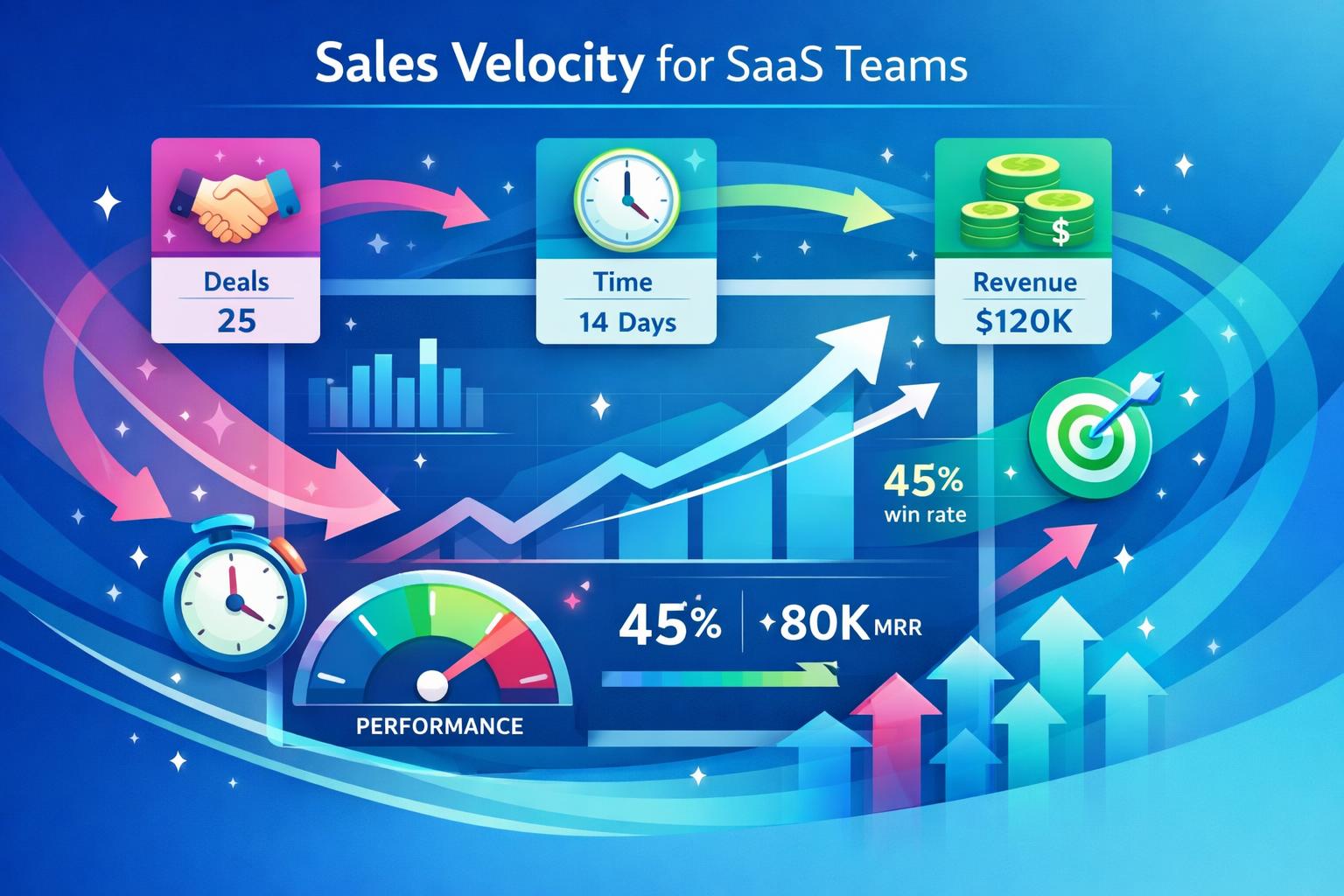
Understanding how efficiently your sales team turns opportunities into actual revenue can make or break a SaaS company’s growth. The sales velocity formula does exactly that by combining deal quantity, size, win rate, and cycle time into a single metric that shows how fast revenue flows through your pipeline. In this post, we’ll break down what sales velocity really means for SaaS teams, how to calculate it using the right inputs, and how to use it to drive smarter forecasting and faster revenue growth.
What Is the Sales Velocity Formula and Why It Matters
The sales velocity formula reveals how much revenue your team generates over time, connecting the dots between opportunities, average deal size, win rate, and sales cycle length. Instead of tracking those metrics in isolation, sales velocity shows how each one impacts your overall revenue momentum.
Simply put, sales velocity answers the question: *How quickly is our process converting pipeline into dollars?* For SaaS teams, where recurring revenue and predictable growth matter most, this metric provides clarity for forecasting and optimization. It highlights where deals slow down and helps prioritize which levers—like increasing win rates or shortening cycles—will yield the biggest payoff.
Sales Velocity = (Number of Opportunities × Average Deal Size × Win Rate) ÷ Sales Cycle LengthWhile the math is straightforward, getting value from this number requires accurate data. SaaS revenue models depend on recurring income and renewal trends, so using consistent metrics like ACV or MRR is critical. Applying the same measurement standards across your reporting ensures your velocity data remains useful for long-term decisions.
“Sales velocity turns fragmented sales metrics into a unified measure of how efficiently your team generates revenue.”
How to Calculate and Improve Sales Velocity in SaaS
To calculate velocity effectively, start with qualified opportunities—deals that have genuine potential to close. Pulling this data from a structured CRM, such as the one within MainFoundry’s CRM reporting tools, ensures accuracy and consistency over time.
Next, define average deal size using the metric that best reflects recurring value—ACV, MRR, or CLV. Consistency is more important than which metric you pick. Use the same measure across dashboards to create alignment between pipeline reviews and revenue forecasts. Your win rate should come from recent data, typically the last few dozen opportunities, to keep it relevant under changing market conditions.
Finally, sales cycle length—the average number of days from qualification to close—is critical for velocity accuracy. Tracking this inside your CRM highlights where deals stall. For example, a SaaS company with 200 qualified opportunities at $10,000 each, a 30% win rate, and an 80-day cycle would see roughly $7,500 in daily revenue. The true insight comes from watching how that number changes over time.
Pro Tip: Use custom workspaces and AI‑powered insights to break down sales velocity by segment, rep, or deal size to pinpoint exactly where optimization will have the fastest impact.
Key Takeaways
- The sales velocity formula measures revenue efficiency, not just volume.
- Apply consistent metrics like ACV, MRR, or CLV when calculating deal size.
- Track your internal trends over time rather than relying on external benchmarks.
- Focus improvements on specific formula components instead of overhauling your entire process.
To see your team’s velocity in real time, unify your sales data under one platform. MainFoundry connects CRM, reporting, and automation so you can identify bottlenecks and accelerate growth. Explore more or get in touch at MainFoundry Contact.