Early-stage SaaS growth rarely comes from launching every acquisition channel at once. Most successful pre-Series B companies grow by identifying one repeatable motion, measuring it carefully, and improving it consistently over time. That focus creates faster learning loops, cleaner operations, and more predictable revenue growth.
This guide explores how lean SaaS teams can build a practical SaaS growth playbook around clear ICP definition, measurable acquisition systems, and connected operational infrastructure. You will learn how product-led growth, SEO, outbound sales, partnerships, and community fit into different growth stages, along with why visibility across your funnel matters more than most founders expect.
Building a Repeatable SaaS Growth Engine
The strongest SaaS companies typically begin with a narrow ideal customer profile and one primary acquisition motion. Instead of spreading resources across SEO, outbound, partnerships, and paid acquisition simultaneously, they focus on identifying what consistently creates qualified pipeline. That discipline prevents operational chaos and accelerates feedback cycles.
For products with fast onboarding and immediate value delivery, product-led acquisition often becomes the most efficient growth path. Free trials, self-serve onboarding, usage-based expansion, and in-product prompts can reduce dependence on expensive sales processes. However, this only works when activation is instrumented carefully and teams understand exactly where users drop off or succeed.
“Growth usually compounds when teams focus on one acquisition loop, measure it rigorously, and scale only after the process becomes predictable.”
Operational infrastructure becomes critical at this stage because disconnected tools make it difficult to understand customer behavior. Tracking lifecycle events, onboarding milestones, and customer interactions inside a unified system gives growth teams the context needed to improve activation continuously. Platforms such as MainFoundry’s CRM platform for lead management and AI-powered workflow tools help centralize customer signals, follow-ups, and product insights in one connected workflow.
Pro Tip: Early-stage growth teams often improve faster by analyzing activation and retention data weekly instead of launching additional acquisition campaigns before understanding existing funnel performance.
Content SEO also remains one of the most durable channels for SaaS because it compounds over time. However, many startups publish broad thought leadership content before validating buyer intent. A more effective strategy focuses on practical customer questions, evaluation criteria, and recurring objections. Instead of maximizing traffic volume, successful teams prioritize attracting buyers actively searching for solutions.
Additionally, SEO strengthens nearly every other acquisition motion. Useful educational content can support outbound campaigns, improve sales conversations, and provide onboarding resources for customer nurture sequences. Over time, your content library becomes a scalable trust-building asset that continues generating qualified leads long after publication.
Using Outbound, Partnerships, and Community to Scale Learning
Outbound sales remains one of the fastest ways for early-stage SaaS companies to understand market demand. Founder-led outreach works especially well when targeting a narrow audience with meaningful contract value. Direct conversations reveal how buyers describe their problems, which objections appear consistently, and what positioning creates urgency.
The objective early on is not scale alone but pattern recognition. Teams that document messaging performance, monitor response rates, and track conversion stages develop repeatable systems much faster than teams relying on intuition. A connected CRM is essential because every meeting, email, and pipeline update contributes to refining the go-to-market strategy. Many growing SaaS teams rely on marketing analytics and attribution tools to connect campaign performance directly to revenue outcomes.
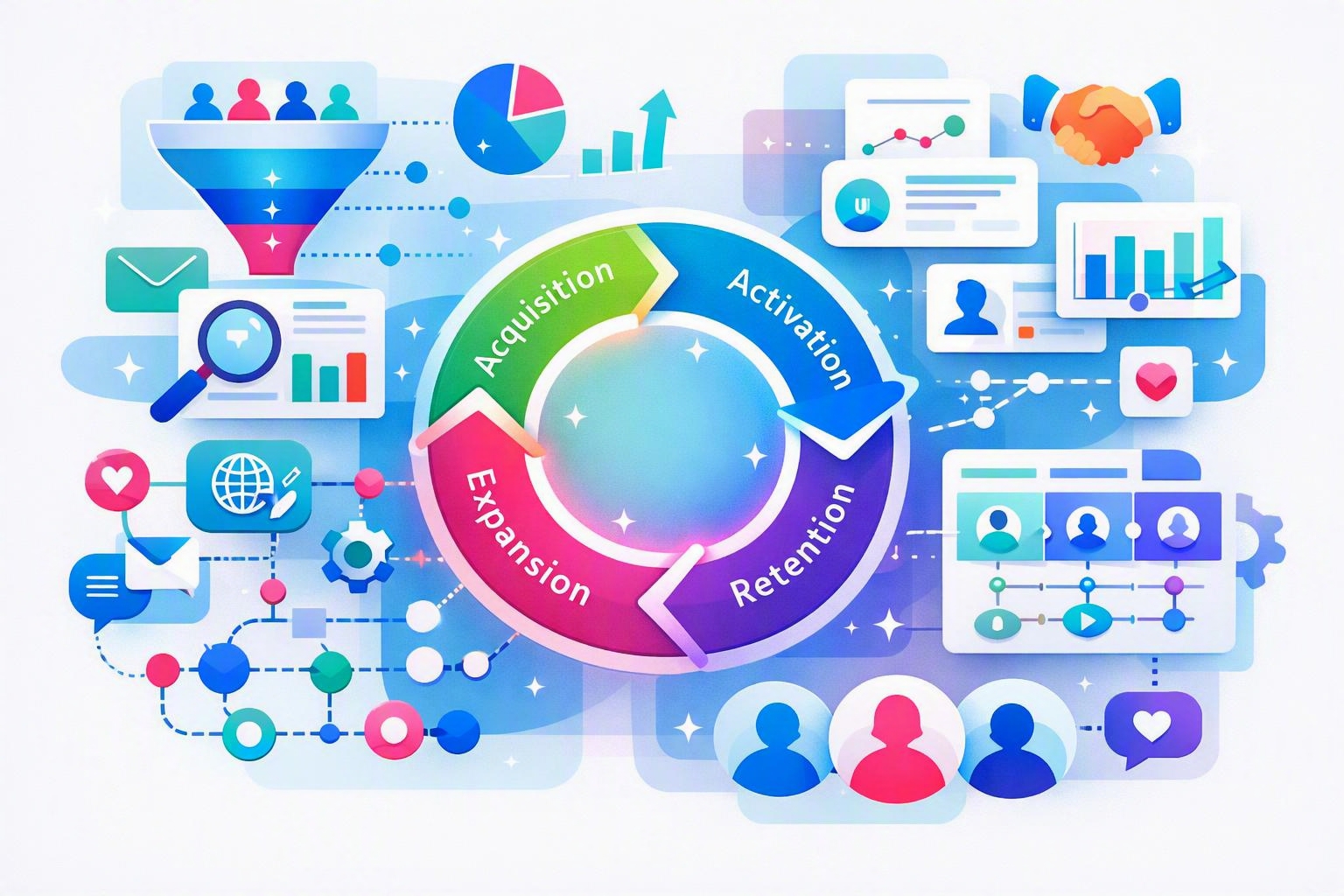
The most effective SaaS growth systems prioritize visibility across acquisition, activation, retention, and expansion instead of treating channels as isolated campaigns.
Once a primary acquisition channel starts producing reliable results, partnerships and community can accelerate growth significantly. Integration partners, consultants, agencies, and adjacent software providers can introduce highly qualified leads that already understand the category problem. In many cases, lightweight integrations, referral relationships, or shared webinars generate meaningful distribution without dramatically increasing acquisition costs.
Community-driven growth is particularly effective for workflow-heavy products where peer learning matters. Smaller advisory groups, operator communities, and customer roundtables often produce stronger engagement than broad public audiences. Customers become active contributors instead of passive users, which improves retention while creating a direct feedback loop for product development.
Across all channels, consistent measurement is the common requirement. SaaS growth stalls when teams cannot identify which channels produce qualified pipeline, which users activate successfully, or which acquisition sources retain best over time. Unified systems simplify this process operationally by connecting campaign data, CRM activity, workflow automation, and lifecycle analytics inside one environment. MainFoundry’s custom business workspaces help teams manage acquisition and customer operations without losing visibility across departments.
Key Takeaways
- Early-stage SaaS growth works best when teams focus on one measurable acquisition motion before expanding into additional channels.
- Product-led growth, SEO, outbound sales, partnerships, and community all require strong visibility into activation, retention, and attribution metrics.
- Connected CRM systems and workflow automation reduce operational friction while improving learning speed across teams.
- Sustainable SaaS growth comes from systems that compound customer insights, revenue data, and go-to-market execution over time.
For pre-Series B teams, the strategic takeaway is straightforward: depth usually matters more than breadth. Build one repeatable acquisition loop, instrument it carefully, and expand only after your data becomes reliable. To unify customer operations, marketing attribution, and growth workflows in one place, explore MainFoundry at https://www.mainfoundry.com.
Related Reading
Learn more about improving lead visibility and customer operations with MainFoundry’s CRM platform for lead management and integrated growth workflows.