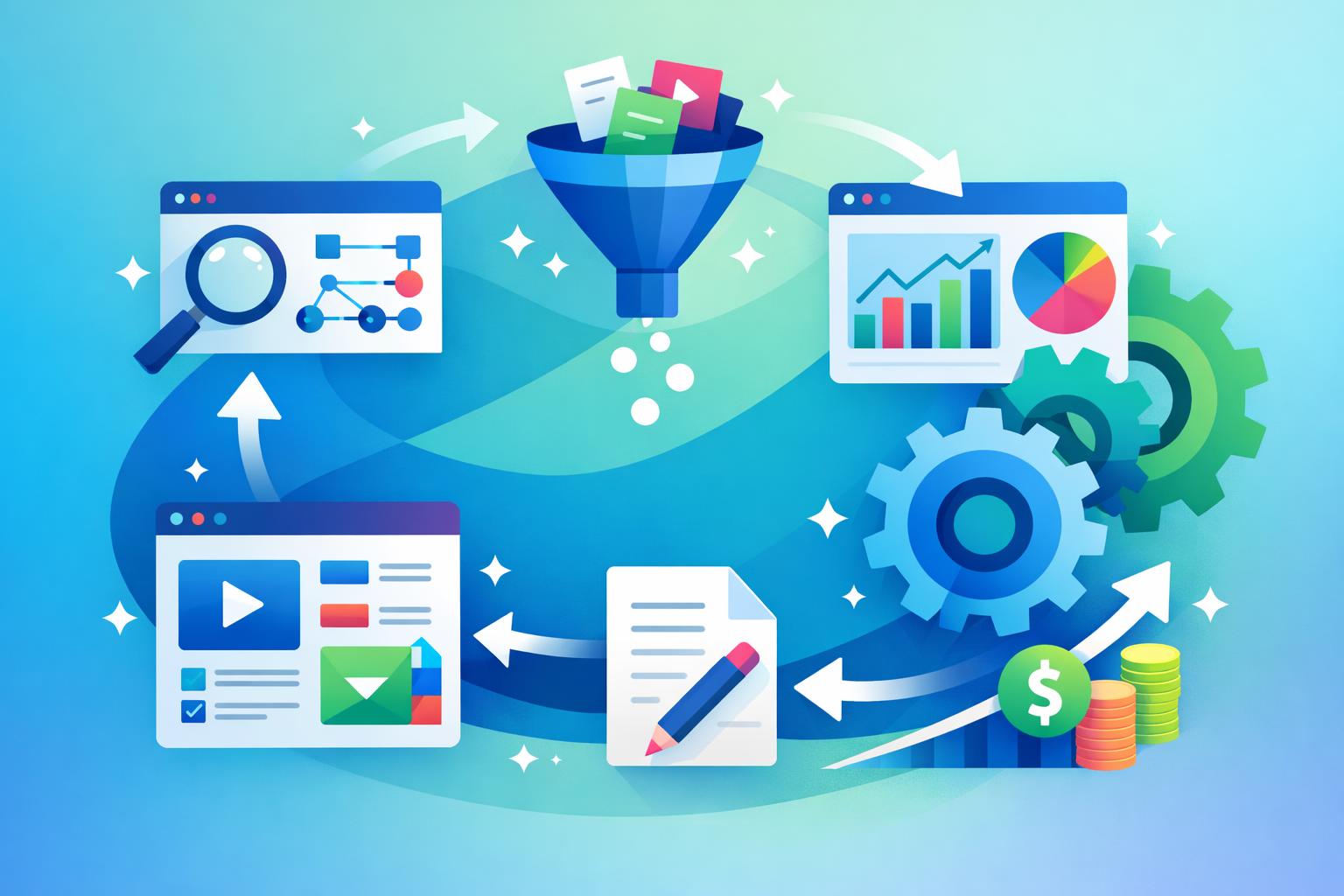
For B2B SaaS companies, publishing endless blog posts isn’t enough to drive growth. What truly works is building a repeatable content marketing engine—a system that attracts qualified buyers, nurtures their evaluation process, and connects content directly to pipeline and revenue. This guide explores how to design that system from the ground up, including strategic planning, effective content formats, distribution, and measurement tied to ROI.
You’ll learn how successful SaaS teams treat content as infrastructure, not a side project, and how platforms like MainFoundry integrate CRM, analytics, and attribution to reveal exactly which assets drive business outcomes.
Build Strategy Tied to Revenue, Not Traffic
The common pitfall in B2B SaaS content marketing is optimizing for keywords without understanding buyers. High traffic from irrelevant audiences rarely turns into customers. Start instead by analyzing existing customers and recent deals to uncover patterns in buyer roles, company size, triggers, and objections. This creates a foundation rooted in actual revenue behavior rather than vanity metrics.
Next, define a small set of content pillars aligned with how buyers evaluate your product category. Strong pillars cover topics like problem education, solution comparison, ROI justification, and workflows that show real-world use cases. Each pillar should map directly to a measurable goal—whether it’s generating demos from your ICP or speeding up in-progress deals.
Once priorities are clear, choose channels based on buyer research. B2B audiences typically rely on search, LinkedIn, professional communities, and trusted review sites. Focusing efforts on a few of these consistently creates stronger awareness than spreading thin across every platform. Using tools like MainFoundry’s unified CRM and marketing platform helps connect topics and assets directly to contacts and opportunities, grounding strategic choices in actual pipeline data.
“A winning content strategy doesn’t start with keywords—it starts with customers and the data that connects them to revenue.”
Create Formats That Move Buyers Through the Funnel
Once strategy is in place, format selection becomes clear. The best B2B SaaS content engines mix demand generation with sales enablement. Comparison content, such as “Your Product vs. Competitor” guides, performs strongly at the bottom of the funnel because it’s aligned to buyer intent. Transparent pros and cons supported by real examples build credibility and influence deals even when not the final touchpoint.
How-to guides and playbooks support the middle of the funnel by helping prospects solve concrete problems while subtly positioning your product as part of the solution. The most effective ones show both generic approaches and product-powered workflows. Data benchmarks and original research add another layer—establishing authority and credibility while earning organic visibility and backlinks over time.
Supporting assets like case studies, walkthroughs, and templates then round out the experience. When linked together with clear calls-to-action and internal navigation, they naturally guide buyers from awareness to decision. Integrating analytics tools such as MainFoundry’s marketing analytics and attribution helps you see how each format contributes across long sales cycles, from first touch to deal close.
Pro Tip: Plan promotion alongside production. Building your distribution plan early ensures content doesn’t stall after launch and keeps the engine running continuously.
Measure Content ROI with Trusted Attribution
Modern SaaS leaders care less about pageviews and more about pipeline impact. Effective teams tag each asset with metadata—pillar, format, funnel stage, and target ICP—then map journeys across anonymous visits, demos, and closed deals. Adopting multi-touch attribution models uncovers how content assists conversions even when it’s not the last touchpoint.
Using tools like MainFoundry’s AI-powered analytics platform consolidates behavior, CRM, and conversion data. This single view lets marketers measure which topics influence qualified deals, shorten cycles, or increase expansion revenue. Over time, this forms a continuous feedback loop—top-performing content gets expanded or repurposed, while underperforming pieces evolve or retire.
When content is tied to revenue, leadership alignment increases—and so does investment in marketing.
Key Takeaways
- Treat content as a system, not a series of disconnected posts.
- Let buyer insights and revenue goals drive your content pillars.
- Focus on comparison, how-to, and data-backed formats that support buying decisions.
- Design distribution alongside production for consistent reach and results.
- Measure impact with multi-touch attribution linked to pipeline, not just traffic.
Ready to transform content into a predictable growth engine? Explore how MainFoundry unifies CRM, analytics, and attribution—or start a conversation at MainFoundry Contact to see the platform in action.