Category: Definitions

  • SaaS Pricing Models for Sustainable Growth

    SaaS Pricing Models for Sustainable Growth

    Choosing the right SaaS pricing models affects far more than monthly recurring revenue. Pricing shapes how customers adopt your product, whether accounts expand over time, and how effectively your business retains users as competition grows. A pricing structure that aligns with customer value can improve expansion revenue and retention simultaneously, while a poorly matched model often creates friction, churn, and slower growth.

    Modern SaaS companies rarely rely on one billing approach forever. Instead, they combine subscriptions, seat-based billing, usage thresholds, and feature tiers to support different customer segments and growth stages. This article explores the five most common pricing models, explains when each works best, and shows how pricing decisions influence metrics including MRR, expansion revenue, and customer retention.

    How Pricing Models Drive SaaS Growth

    Every pricing strategy starts with understanding what customers perceive as value. For some platforms, value increases when more employees adopt the software. For others, value scales with API requests, transactions processed, or feature access. The strongest pricing strategies connect customer outcomes directly to how billing works.

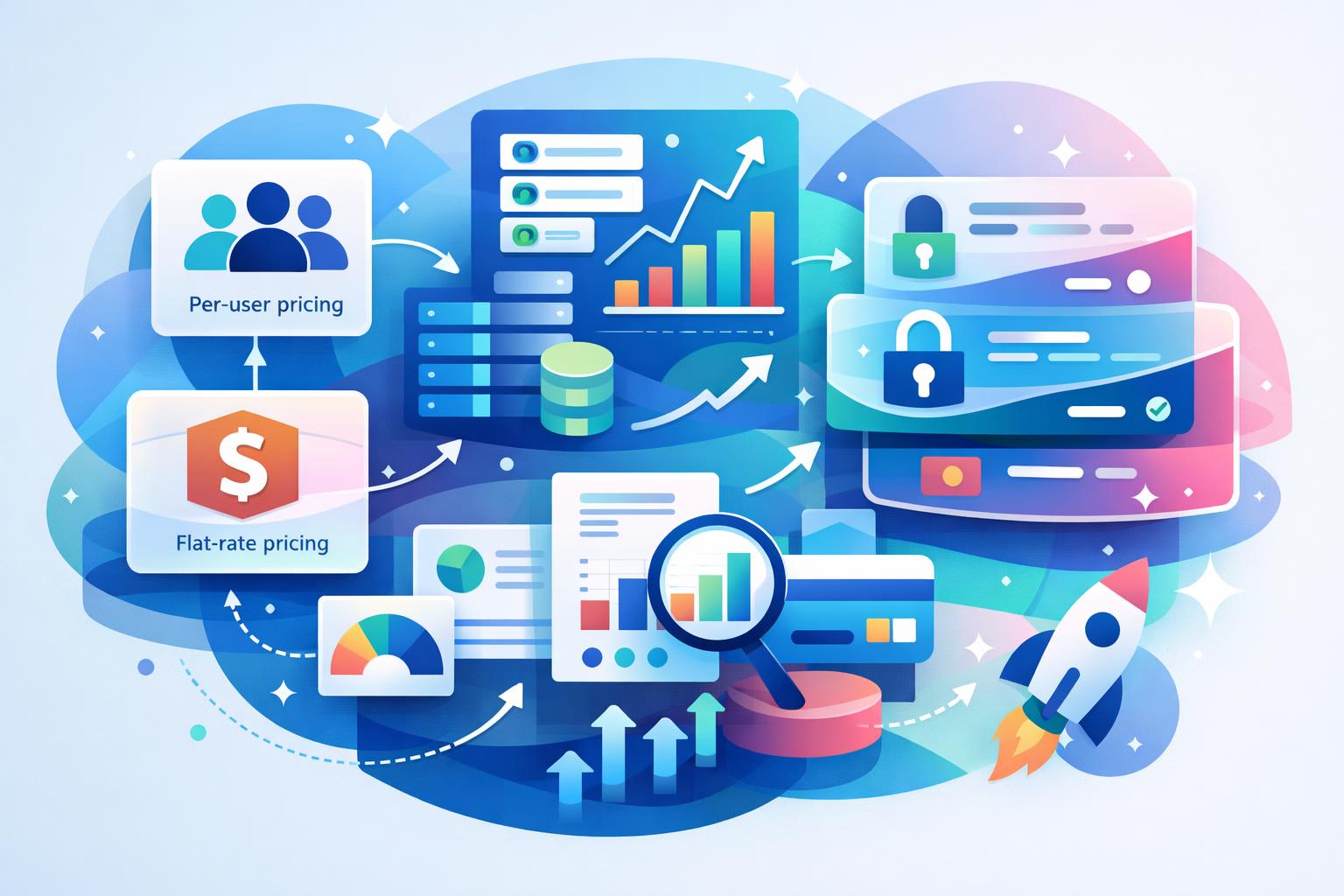
    Flat-rate pricing remains one of the simplest structures because customers pay a single recurring fee for complete access. This reduces buying friction and can accelerate adoption for early-stage SaaS companies with straightforward positioning. However, expansion opportunities become limited because larger customers pay the same as smaller accounts, making growth dependent on acquiring new customers instead of expanding existing ones.

    In contrast, per-seat pricing scales naturally alongside adoption. Collaboration software and CRM platforms frequently use this structure because customers clearly understand the relationship between user count and delivered value. Yet seat-based billing can create unintended friction if companies restrict licenses or encourage account sharing to manage costs, particularly when product adoption directly improves retention.

    “The most effective SaaS pricing models evolve alongside customer behavior rather than remaining static after launch.”

    Usage-based pricing, sometimes called consumption pricing, takes a different approach by charging customers according to activity levels such as storage consumed, messages sent, or transactions processed. This lowers the barrier to entry because customers can start with smaller commitments and scale gradually. Infrastructure providers and API-driven platforms often favor this model because usage directly reflects value delivered.

    Pro Tip: Usage-based pricing works best when paired with predictable guardrails such as prepaid usage blocks, thresholds, or hybrid subscriptions that help customers forecast costs more accurately.

    Many SaaS businesses also layer in tiered pricing to support different customer segments. Startups may only require core functionality, while enterprise accounts often need advanced analytics, permissions, or compliance controls. Combining tiered plans with usage or seat-based billing allows companies to capture a wider range of willingness-to-pay without creating custom contracts for every customer.

    Freemium pricing supports product-led growth by allowing users to continue using a limited version indefinitely instead of relying solely on time-based trials. This can dramatically improve top-of-funnel growth because customers experience the product before making purchasing decisions. However, free users still create infrastructure and support costs, which means businesses need strong upgrade paths and sustainable conversion economics.

    As pricing strategies become more sophisticated, operational flexibility becomes increasingly important. Platforms such as MainFoundry provide configurable subscription and billing management within its finance and billing tools, allowing businesses to structure recurring subscriptions, track expansion metrics, and adapt pricing without rebuilding systems from scratch.

    How Pricing Decisions Influence Retention and Revenue Metrics

    Pricing decisions influence nearly every major SaaS growth metric, including customer acquisition cost, retention, expansion revenue, and lifetime value. Simpler models often improve conversion because buyers quickly understand the offer. Flat-rate and straightforward seat-based pricing can reduce friction during sales conversations, while freemium and consumption models encourage adoption by lowering upfront commitment.

    Expansion revenue becomes easier to scale when pricing naturally grows alongside customer adoption and product usage.

    Expansion mechanics vary significantly between pricing structures. Per-seat pricing grows as additional users join the platform, while consumption pricing expands through increased activity levels. Tiered pricing supports account growth by encouraging upgrades as customer requirements mature. Flat-rate pricing generally provides fewer built-in expansion opportunities unless paired with add-ons or premium modules.

    Retention also improves when pricing aligns closely with perceived customer value. Businesses are more likely to renew subscriptions when costs scale naturally alongside outcomes. Problems emerge when pricing feels disconnected from actual usage, including expensive seat requirements for lightly engaged teams or unpredictable usage bills that create budgeting concerns for growing customers.

    To evaluate pricing performance effectively, SaaS teams need visibility into both financial and product data. Monitoring metrics such as expansion MRR, conversion from free to paid plans, retention by pricing tier, CAC payback periods, and revenue concentration helps businesses identify whether pricing aligns with customer behavior and growth goals.

    • Track expansion MRR separately for each pricing structure to identify which models support scalable growth.
    • Measure retention by customer tier to understand whether pricing aligns with long-term value perception.
    • Connect product usage, acquisition data, and billing performance to improve pricing decisions over time.

    Connecting these insights across separate tools can become operationally difficult. MainFoundry helps centralize that visibility by combining CRM management, marketing analytics, and subscription tracking in a unified environment. This allows teams to connect pricing performance directly to customer acquisition, adoption patterns, and recurring revenue outcomes.

    Key Takeaways

    The most effective SaaS pricing strategies evolve alongside customer expectations, product capabilities, and market positioning. Businesses that treat pricing as an operational growth strategy rather than a one-time decision are often better positioned to improve retention and expand recurring revenue sustainably.

    Flat-rate pricing simplifies adoption, while seat-based and usage-driven models create stronger expansion opportunities. Tiered pricing helps companies serve multiple customer segments efficiently, and freemium strategies can accelerate growth when upgrade paths and infrastructure costs remain balanced.

    If your business is evaluating subscription operations or hybrid billing strategies, explore how MainFoundry’s custom operational workspaces and billing tools can support scalable SaaS pricing management.

    Related Reading

    Learn more about scalable subscription operations with MainFoundry’s finance and billing tools and explore customer growth insights through integrated CRM management solutions.

  • SaaS Pricing Models for Sustainable Revenue Growth

    SaaS Pricing Models for Sustainable Revenue Growth

    Choosing the right SaaS pricing models affects far more than monthly invoices. Pricing influences customer acquisition, retention, expansion revenue, and the long-term scalability of your business. A structure that works during early growth may eventually limit monetization opportunities as customer needs become more complex.

    Modern SaaS companies typically build around approaches such as flat-rate, per-seat, usage-based, tiered, or freemium pricing. Increasingly, businesses combine several models into flexible hybrid systems that evolve alongside product maturity and customer expectations. This guide explains how each pricing model impacts revenue growth, where each structure performs best, and why operational flexibility has become essential for sustainable SaaS expansion.

    How Pricing Models Shape SaaS Revenue Growth

    Pricing directly impacts metrics including MRR, ARR, churn, customer acquisition cost, and net revenue retention. A simpler structure may improve conversion rates early in a company’s lifecycle, while a more flexible system can unlock expansion revenue as customers increase adoption and usage over time.

    Flat-rate pricing remains one of the simplest approaches because customers pay a single recurring fee for access. This works particularly well when product value comes from access itself rather than usage volume. Early-stage SaaS businesses often prefer this model because forecasting stays predictable and the buying process feels straightforward for customers.

    However, flat-rate pricing can cap growth potential. A large customer generating significant business value may pay roughly the same amount as a much smaller customer, limiting average revenue per user and reducing opportunities for account expansion.

    “The most effective SaaS pricing systems evolve alongside customer growth instead of remaining static forever.”

    Per-seat pricing addresses part of this limitation by tying revenue growth to user adoption. Collaboration tools, CRMs, and internal productivity platforms commonly use this structure because revenue naturally increases as more employees rely on the product. Some SaaS companies reduce adoption friction by charging only for active users rather than every account provisioned within a workspace.

    In contrast, usage-based pricing connects revenue directly to consumption metrics such as API calls, storage usage, transactions processed, or messages sent. Infrastructure and API-driven products frequently benefit from this approach because customers can start with lower risk and scale spending as value increases. Revenue expansion often becomes stronger over time, although enterprise buyers sometimes prefer more predictable billing structures.

    Hybrid pricing models are becoming the standard because different customer segments expect different ways to pay for value.

    Tiered pricing functions more as a packaging framework than a standalone billing model. Companies create multiple plans aimed at startups, mid-market teams, and enterprise buyers, each with varying feature access, support levels, or usage thresholds. When executed well, tiers create a clear upgrade path that supports expansion without overwhelming buyers with complexity.

    Many businesses also incorporate freemium acquisition strategies to support product-led growth. A permanent free plan lowers adoption barriers and allows users to experience value before upgrading. The economics require close monitoring, though, because infrastructure and support costs still apply to non-paying users. Companies that succeed with freemium usually create strong upgrade triggers tied to collaboration, premium functionality, or usage limits.

    As pricing complexity increases, operational flexibility becomes essential. Platforms such as MainFoundry simplify this process through integrated subscription and billing management systems that support configurable pricing logic, recurring billing workflows, and customer analytics in one environment.

    Choosing the Right Pricing Structure for Your Product

    The best pricing strategy aligns directly with how customers experience value. If success depends on the number of people collaborating within a platform, per-seat pricing often feels intuitive. If value comes from automation workflows, API consumption, or transaction volume, usage-based pricing may create stronger alignment between customer outcomes and revenue generation.

    SaaS pricing systems rarely stay fixed. Companies continuously adjust feature packaging, usage thresholds, support levels, and billing structures as customer behavior evolves. For example, a business may begin with a single flat-rate plan during its MVP phase, then later introduce segmented tiers and usage-based add-ons as larger customers demand greater flexibility.

    Pro Tip: Pricing infrastructure matters as much as pricing strategy. Your team should be able to test new packaging, evaluate cohort performance, and adjust billing logic without rebuilding operational systems every time the business evolves.

    Operational scalability becomes especially important once hybrid pricing enters the picture. A SaaS company might use freemium acquisition for small businesses, per-seat pricing for collaboration features, and usage-based billing for automation or API access. Managing these layers manually often creates reporting gaps and operational friction across finance, RevOps, and customer success teams.

    MainFoundry helps address these challenges through integrated custom workspace tools that organize pricing logic, customer segments, and plan configurations inside a centralized system. Teams can also evaluate pricing experiments using connected marketing analytics and attribution workflows tied directly to recurring revenue metrics.

    Visibility across pricing performance is critical because every pricing adjustment creates tradeoffs. A lower-cost structure may increase conversions while reducing expansion potential. Likewise, aggressive usage-based billing can improve short-term revenue but introduce churn risk if customers view costs as unpredictable. Sustainable growth depends on balancing acquisition, retention, and monetization together rather than optimizing one metric in isolation.

    Key Takeaways

    • Flat-rate pricing supports simplicity and easier onboarding but can limit expansion revenue over time.
    • Per-seat and usage-based pricing models align revenue growth more closely with customer adoption and product consumption.
    • Tiered and freemium strategies help improve segmentation and acquisition when supported by clear upgrade paths.
    • Hybrid pricing structures increasingly provide the flexibility modern SaaS businesses need to support multiple customer segments.
    • Flexible operational systems make it easier to test, evolve, and scale pricing strategies without creating unnecessary complexity.

    If your organization is evaluating pricing strategy or modernizing subscription operations, explore how MainFoundry’s finance and billing tools and AI-powered workflow platform can help unify pricing, analytics, and customer growth in a single environment.

    Related Reading

    Learn more about optimizing recurring revenue operations with subscription and billing management solutions designed for growing SaaS businesses.

  • SaaS Pricing Models for Sustainable Subscription Growth

    SaaS Pricing Models for Sustainable Subscription Growth

    Choosing the right SaaS pricing model affects far more than your monthly recurring revenue. Pricing shapes how customers perceive value, how easily they adopt your product, and whether expansion revenue becomes predictable over time. A pricing structure that aligns with customer outcomes can accelerate growth, while a poorly designed model often creates friction that limits retention and scalability.

    This guide explains the most common SaaS pricing approaches, including flat-rate, per-seat, usage-based, tiered, and freemium models. You’ll also see how operational systems influence pricing flexibility and why platforms such as MainFoundry help SaaS companies manage subscriptions, analytics, and billing workflows without adding unnecessary complexity.

    How Pricing Models Drive SaaS Revenue Growth

    Every pricing structure creates a different growth dynamic. Some models rely heavily on acquiring new customers, while others naturally increase revenue as customers expand usage, onboard more employees, or adopt advanced capabilities. Understanding these tradeoffs helps you align pricing with long-term business strategy.

    Flat-rate pricing remains one of the simplest approaches because customers pay one recurring fee regardless of usage or team size. This structure works well for products where access itself represents the core value, including research databases, compliance platforms, and niche industry software. Buyers often appreciate the clarity because budgeting becomes straightforward and purchasing decisions move faster.

    However, flat-rate pricing can limit expansion opportunities. Heavy users may consume significantly more resources without paying more, while lighter customers may question whether the cost reflects their actual usage. SaaS businesses using this model often depend heavily on new customer acquisition for growth. Operational visibility becomes essential, which is why tools like subscription and billing management systems help track retention trends, recurring revenue, and customer profitability over time.

    “The strongest SaaS pricing structures align revenue growth with how customers experience value.”

    Per-seat pricing takes a different path by charging based on the number of licensed users. Collaborative software products, including CRMs, communication platforms, and project management tools, frequently use this structure because value increases as more employees adopt the product. A customer may begin with a small team and gradually expand usage across multiple departments, creating a natural expansion revenue engine.

    Additionally, seat growth often provides early operational signals about customer health. Shrinking license counts may indicate churn risk before cancellation occurs, while expanding usage usually reflects stronger product adoption. Still, this model can become less effective when customer outcomes depend more on automation, infrastructure processing, or API activity than individual users.

    Pricing is not just a billing decision. It directly shapes retention, expansion revenue, and customer behavior.

    Usage-based pricing, also called consumption pricing, has become increasingly common among API platforms, AI products, analytics services, and infrastructure providers. Instead of charging per user, companies bill customers according to measurable activity, including API calls, storage consumption, generated outputs, or processing volume. This creates strong alignment between customer success and revenue growth because spending increases naturally alongside product adoption.

    The challenge with consumption pricing is predictability. Revenue can fluctuate significantly when customer usage patterns vary month to month, and buyers may hesitate if pricing feels difficult to estimate. Accurate measurement, transparent invoicing, and real-time visibility become essential. Platforms with integrated finance management capabilities help SaaS companies handle recurring invoicing, usage tracking, and flexible subscription logic more effectively.

    Tiered and Freemium Pricing for Scalable Expansion

    Tiered pricing introduces structured packages designed for different customer segments. SaaS businesses typically offer entry-level, professional, and enterprise plans with varying feature sets, limits, or support levels. Smaller businesses can access core functionality at lower costs, while larger organizations gain advanced integrations, reporting capabilities, compliance tools, and dedicated support.

    One reason tiered pricing works so well is that it creates clear upgrade paths. Customers can start with affordable plans and move upward as operational complexity increases. However, overly complicated tiers often slow conversions because buyers struggle to understand feature boundaries. Strong tier structures keep differences obvious and tied directly to customer outcomes.

    Pro Tip: Pricing tiers perform best when each upgrade solves a meaningful operational problem rather than simply unlocking random features.

    Freemium models focus primarily on customer acquisition by offering limited free access before requiring payment for advanced capabilities or higher usage limits. This structure can dramatically increase top-of-funnel growth because users experience the product before making a financial commitment. Self-serve SaaS businesses often use freemium strategies to reduce acquisition costs and accelerate adoption.

    Successful freemium products carefully balance accessibility with conversion incentives. Free users still generate infrastructure and support costs, so companies typically reserve collaboration features, advanced analytics, or higher activity thresholds for paid plans. Businesses that connect product analytics with customer and billing data can identify product-qualified leads more effectively through systems like CRM and customer management tools and marketing analytics platforms.

    In reality, many SaaS companies combine several pricing approaches together. A collaboration product may use tiered plans with per-seat billing inside each package, while an AI platform may charge a flat subscription fee plus consumption-based API costs. As these combinations evolve, operational flexibility becomes increasingly important.

    Modern SaaS operations require systems capable of managing changing pricing logic, subscription adjustments, customer segmentation, and analytics simultaneously. Flexible tools such as custom business workspaces help teams connect finance, CRM, marketing, and workflow automation in a single operational environment.

    Key Takeaways

    • Flat-rate pricing offers simplicity but may limit expansion revenue opportunities over time.
    • Per-seat and usage-based pricing naturally support scalable revenue growth when aligned with customer value.
    • Tiered and freemium models help SaaS companies serve multiple customer segments while creating structured upgrade paths.
    • Flexible operational infrastructure is essential for managing hybrid pricing, subscription changes, and revenue analytics efficiently.

    SaaS pricing should evolve alongside your product and customer base. Businesses that consistently monitor plan adoption, upgrade behavior, usage trends, and churn indicators are better positioned to refine pricing decisions quickly. If your team needs more adaptable workflows for subscriptions, analytics, and billing operations, explore MainFoundry’s platform capabilities at https://www.mainfoundry.com or learn more about tailored operational workflows at https://www.mainfoundry.com/contact.

    Related Reading

    Learn more about optimizing recurring revenue operations with subscription and billing management tools designed for modern SaaS businesses.

  • SaaS Pricing Models for Sustainable Growth

    SaaS Pricing Models for Sustainable Growth

    Choosing the right SaaS pricing models can influence far more than monthly revenue. Pricing affects how customers evaluate your product, how quickly sales cycles move, and whether expansion revenue grows naturally over time. Many SaaS companies begin with simple subscription structures, then evolve toward hybrid approaches as they learn more about customer behavior and operational costs.

    This guide explains the five most common SaaS pricing models, including flat-rate, per-seat, usage-based, tiered, and freemium pricing. You will also learn how each model impacts metrics such as ARPU, churn, CAC payback, and net revenue retention. Additionally, the article explores why flexible systems like MainFoundry’s subscription and billing tools are becoming increasingly important for scaling SaaS businesses.

    How the Main SaaS Pricing Models Work

    Flat-rate pricing remains one of the simplest subscription structures available. Customers pay a recurring fee for product access with minimal restrictions, making the value proposition easy to understand. This approach often works well for early-stage products validating demand or niche software with predictable usage patterns. However, expansion potential becomes limited when heavy users consume significantly more resources without increasing revenue.

    In contrast, per-seat pricing connects revenue directly to user growth. Collaboration software, CRM platforms, and project management tools commonly use this structure because adoption typically spreads across teams over time. As organizations add employees, subscription revenue expands naturally. Some companies reduce friction further with per-active-user billing, where customers only pay for users who actively engage during the billing cycle.

    “Modern SaaS businesses rarely rely on a single pricing model forever. Hybrid pricing has become the standard for sustainable growth.”

    Usage-based pricing, sometimes called consumption pricing, ties cost directly to activity such as API calls, transactions, storage, or messages sent. Infrastructure and developer-focused products often benefit from this structure because spending scales alongside customer success. While this model lowers barriers to entry and creates strong expansion opportunities, customers may become cautious if billing feels unpredictable.

    Tiered pricing introduces multiple packages for different customer segments, including plans such as Starter, Growth, and Enterprise. In practice, tiered structures usually complement another pricing model rather than replacing it. Effective packaging creates clear upgrade paths, while poor tier design can create unnecessary confusion and pricing friction.

    Freemium pricing supports product-led growth by offering limited free access before monetization. Collaboration and productivity platforms frequently succeed with this strategy because users can experience value quickly and invite others into the platform. However, sustainable freemium models require clear upgrade triggers and manageable infrastructure costs.

    Pro Tip: Hybrid pricing structures often outperform single-model strategies because they align monetization with multiple customer segments and usage patterns.

    As SaaS businesses evolve, flexible billing systems become increasingly important. MainFoundry’s billing and finance management tools help companies configure hybrid pricing without rebuilding subscription infrastructure from scratch. Teams can connect recurring billing, revenue tracking, and financial reporting into a single operational workflow.

    How SaaS Pricing Models Influence Growth Metrics

    Pricing strategy directly shapes the metrics investors and operators monitor most closely. A model optimized for rapid customer acquisition may reduce expansion revenue, while aggressive monetization can increase churn if customers perceive pricing as unfair. The strongest pricing structures balance growth, predictability, and customer trust.

    • ARPU and expansion revenue often improve with per-seat and usage-based pricing because customer spending increases alongside growth.
    • CAC payback typically improves when pricing remains simple and easy for buyers to understand during sales cycles.
    • Net revenue retention benefits from upgrade paths, feature tiers, and usage-driven expansion opportunities.
    • Churn behavior varies by pricing structure, including seat reductions in per-user models and cost optimization in consumption-based products.

    Beyond metrics, pricing also shapes customer psychology. Flat-rate pricing creates predictability and budget confidence, while usage-based pricing aligns spending more closely with measurable value delivered. Freemium models encourage experimentation, especially when upgrade paths feel intuitive rather than restrictive.

    The best SaaS pricing strategies evolve alongside customer behavior, product adoption, and revenue goals.

    Different customer segments often respond to different monetization approaches. Enterprise buyers may prefer predictable subscriptions and committed contracts, while smaller customers favor low-friction usage-based entry points. This creates a strong case for flexible pricing infrastructure that supports experimentation without operational disruption.

    MainFoundry supports these evolving requirements by helping businesses test pricing changes, launch feature-based tiers, and combine subscription billing with consumption-based pricing. Teams can also connect pricing performance to marketing analytics and attribution reporting to understand how pricing impacts acquisition and retention across channels.

    As revenue scales, centralized pricing visibility becomes increasingly valuable. Monitoring seat expansion, upgrade behavior, and churn patterns in one system helps operators identify what is truly driving sustainable growth. Combined with unified CRM and customer management, pricing data becomes part of a broader operational strategy rather than an isolated finance task.

    Key Takeaways

    The most effective SaaS pricing models align directly with how customers experience value. Collaboration products often benefit from per-seat pricing, infrastructure tools commonly succeed with usage-based billing, and product-led growth companies frequently combine freemium access with tiered upgrades.

    Sustainable pricing strategies should remain flexible as your market evolves. Businesses that continuously refine packaging, limits, and monetization structures are often better positioned to improve retention, increase ARPU, and strengthen net revenue retention over time.

    If your company is evaluating subscription models, hybrid billing structures, or usage-based monetization, explore how MainFoundry helps businesses manage pricing, finance, and customer operations within one connected platform at https://www.mainfoundry.com.

    Related Reading

    Learn more about optimizing subscription operations with billing and finance management tools designed for growing SaaS companies.

  • CRM Data Enrichment That Improves B2B SaaS Sales

    CRM Data Enrichment That Improves B2B SaaS Sales

    Most revenue challenges in B2B SaaS don’t begin with poor messaging or underperforming sales reps—they start with incomplete data. A lead record with just an email and company name can’t provide the insight needed to sell effectively. That’s where data enrichment transforms the picture by turning static fields into actionable sales intelligence. In this post, you’ll learn what enrichment means for SaaS teams, how automation and AI change the game, and why enriched data drives faster, smarter selling decisions.

    From Static Records to Context-Driven Intelligence

    At its core, data enrichment means adding meaningful context to information you already have. B2B SaaS companies collect basic first‑party data from demo forms, trials, and product interactions—but alone, that data provides little guidance. By enriching it with verified details like company size, industry, and technology usage, sales teams can instantly understand whether an account fits their ideal customer profile.

    This process moves CRM databases from static snapshots to living systems that evolve over time. When enrichment runs continuously, records stay fresh even as job titles or tech stacks change. A rep viewing an enriched profile sees up-to-date context about the account’s tools, growth signals, and even intent patterns—insight that used to require hours of manual research.

    “Effective data enrichment turns a CRM from a database into a source of decision‑ready intelligence.”

    Real-world value emerges through categories like firmographic, technographic, and intent enrichment. Firmographic intelligence provides quick qualification; technographics uncover what systems a prospect relies on; and intent signals reveal who’s actively researching solutions. Together, they help teams personalize outreach and prioritize accounts most likely to convert.

    Automation and AI: Turning Enriched Data into Action

    Manual data enrichment once meant endless tab‑switching between LinkedIn, press releases, and job boards—useful for a handful of accounts, impossible at scale. Automated enrichment flips that dynamic by syncing directly with CRM and marketing platforms. Incoming leads are enriched instantly; existing records are refreshed on schedule; and every profile gains consistent context without human intervention.

    Platforms like MainFoundry extend this automation through unified CRM and contact management, connecting firmographic, technographic, and intent signals directly to lead scoring and routing. Its AI Assistant turns enriched data into instant recommendations by summarizing account context or suggesting next actions based on observed trends. That means teams don’t just have better data—they act on it faster and more consistently.

    Enrichment feeds AI, AI feeds workflows, and workflows drive measurable improvements in sales execution.

    Additionally, because MainFoundry integrates marketing analytics and finance data within the same environment, enriched records influence far more than sales. Marketing teams gain cleaner targeting and attribution models, while revenue leaders get more reliable forecasting. AI ensures that context doesn’t stay buried—it becomes operational intelligence shared across every department.

    Key Takeaways

    • Data enrichment converts static CRM data into actionable intelligence that sharpens qualification and personalization.
    • Automated enrichment ensures freshness and consistency, freeing your sales team to focus on high‑value outreach.
    • AI‑driven platforms like MainFoundry operationalize enriched data into daily actions and recommendations.
    • Connecting enrichment to marketing and finance unlocks cross‑functional insights and more accurate forecasting.
    • To see how enriched data and AI combine for better outcomes, start exploring MainFoundry’s platform or reach out via contact page.

    Related Reading

    Explore how MainFoundry CRM unifies enriched data for faster and smarter sales execution.

  • Expense Management SaaS Guide for SaaS Finance Teams

    Expense Management SaaS Guide for SaaS Finance Teams

    In fast-scaling SaaS companies, expenses shape how investors measure efficiency and how leaders steer growth. Because costs typically surge before revenue stabilizes, even small misclassifications can distort margins, burn rate, and cash flow forecasts. This guide breaks down how to manage expenses strategically—covering accurate cost classification, burn and runway tracking, budgeting discipline, and audit readiness. You’ll also see how a centralized platform like MainFoundry turns these processes into a synchronized financial engine.

    Why Expense Management SaaS Matters for Modern Companies

    SaaS companies follow a different financial rhythm. Product development, infrastructure, and customer acquisition investments occur well before recurring revenue stabilizes. That lag makes expense visibility essential from the earliest growth stages. Investors especially scrutinize burn efficiency and gross margin, so accurate categorization shapes credibility as much as accounting accuracy.

    A sound approach begins with precise cost classification. Knowing which expenses belong in Cost of Goods Sold (COGS) versus Operating Expenses (OpEx) directly impacts reported margins. Hosting, infrastructure, and customer support tied to active users fall under COGS since they scale with service delivery. Sales, marketing, and R&D are OpEx because they fuel growth rather than delivery.

    Maintaining this consistency gets tougher as headcount grows and roles blend across functions. That’s where systems like MainFoundry’s subscription and billing management tools help by embedding categorization logic directly into every expense workflow. These tools align cost centers, enforce approval flows, and ensure clarity across teams.

    Another crucial factor is burn rate. Gross burn shows total outflows; net burn subtracts monthly revenue to reveal actual cash loss. SaaS leaders depend on these metrics to decide when to adjust hiring or marketing spend. Effective expense management software distinguishes cash timing from accrual data, helping teams spot risks before runway shortens.

    Budgets connect every level—from COGS and R&D to Sales and G&A—into unified spending plans. When expense tracking platforms offer real-time budget visibility, teams can correct course instantly instead of reacting weeks later. Meanwhile, a centralized repository combines receipts, approvals, and audit trails that make diligence processes smoother and faster.

    “Expense visibility is not merely about cost tracking—it’s the foundation of financial trust and strategic agility.”

    How Expense Management SaaS Handles COGS, OpEx, Burn, and Budgets

    Accurate expense categorization remains the cornerstone of reliable reporting. COGS covers direct service delivery costs—such as cloud infrastructure, production DevOps, and customer support without sales responsibilities. When these costs rise faster than recurring revenue, gross margin erodes, and leaders must act fast to sustain efficiency.

    OpEx supports ongoing operations—think R&D, sales salaries, legal fees, and general administration. While COGS reflects scalability, OpEx signals long-term investment. Misclassifying these lines can mislead stakeholders, which is why documentation and enforcement matter so much. For instance, customer success might belong to COGS if responsible for retention, or OpEx if driving upsells.

    MainFoundry’s Expenses module empowers finance teams to formalize these boundaries through custom mapping and approval workflows. Rules specify which vendors and departments align with each cost category, ensuring every transaction adheres to company policy.

    Example: AWS invoices → auto-tagged as COGS
    Salesforce license → auto-tagged as Sales OpEx

    Because costs are categorized by department, timing, and cash flow, finance leaders can analyze burn composition and model scenarios quickly. Whether adjusting hiring or renegotiating contracts, transparent expense data supports evidence-based decisions. Integrated with secure financial data management practices and adaptable flexible workspaces, these insights remain reliable even as systems evolve.

    Unified expense systems transform raw transaction data into dynamic forecasts that guide better strategic decisions.

    Key Takeaways

    • A robust expense management SaaS system integrates cost classification, burn analysis, budgeting, and audit control into one workflow.
    • Consistent COGS vs. OpEx rules safeguard margin accuracy and enhance investor trust during scaling.
    • Real-time visibility turns raw expense data into early signals for burn and efficiency management.
    • Embedded budgets empower teams to stay accountable before overspending occurs.
    • Centralized records and automated approvals keep finance teams audit-ready year-round.

    To explore how integrated expense management can strengthen your financial operations, visit MainFoundry or connect with the team at MainFoundry Contact.

  • Moms på SaaS-abonnementer med OSS og reverse charge

    Moms på SaaS-abonnementer med OSS og reverse charge

    Moms på SaaS‑abonnementer er et område, hvor mange leverandører oplever usikkerhed, fordi reglerne afhænger af kundetype, land og faktureringsopsætning. Denne artikel giver dig en praksisnær gennemgang af, hvordan moms på SaaS håndteres korrekt i Danmark og EU – inklusive reglerne for reverse charge, OSS‑ordningen og korrekt B2B‑fakturering. Du får indsigt i, hvordan moderne SaaS‑virksomheder kombinerer systemer som MainFoundry og e‑conomic for at sikre automatiseret og compliant fakturering.

    Hvornår er SaaS momspligtigt – og hvor er leveringsstedet?

    En SaaS‑ydelse anses i momslovgivningen som en elektronisk leveret tjenesteydelse. Det betyder, at leveringsstedet – altså hvor momsen skal betales – afhænger af kundens etableringsland og status som virksomhed eller privatperson. Det første spørgsmål er derfor altid, hvem kunden er, og hvor kunden bor. Det afgør, om du skal bruge dansk moms, anvende reverse charge eller opkræve lokal moms via OSS‑ordningen.

    Sælger du SaaS til danske kunder, skal du fakturere med 25 % dansk moms – uanset om kunden er B2B eller B2C. For B2B‑kunder kan momsen fradrages, men for dig som leverandør gælder det som almindelig momspligtig ydelse. Fejlkilden opstår, når kunderne befinder sig i andre EU‑lande, for her ændrer leveringsstedet sig, og dermed også, hvem der skal afregne momsen.

    Ved salg til EU‑virksomheder med gyldigt VAT‑nummer anvendes reverse charge‑princippet. Du fakturerer uden moms, og kunden afregner selv moms i sit hjemland. Overfor EU‑privatkunder skal du derimod opkræve moms med den sats, der gælder i kundens land, og afregne via OSS‑ordningen. For kunder uden for EU anses salget som eksport af ydelser og er som udgangspunkt uden dansk moms. Disse scenarier er kernen i enhver korrekt SaaS‑momsopsætning.

    “Leveringsstedet for SaaS‑ydelser afhænger af kundens placering – ikke leverandørens.”

    Reverse charge, OSS og B2B‑fakturering i praksis

    I praksis betyder reverse charge, at du ikke opkræver moms, men kunden gør det i sit eget land. For at anvende ordningen korrekt skal du verificere kundens VAT‑nummer, angive det på fakturaen og inkludere en tekst, der tydeligt markerer omvendt betalingspligt. Uden disse elementer kan salget blive vurderet som momspligtigt i Danmark, hvilket kan udløse efteropkrævning.

    Også på systemniveau spiller opsætningen en rolle. Hvis du bruger MainFoundrys fakturering i integration med e‑conomic, kan systemet automatisk vælge den rette momskode baseret på kundedata. Dermed sendes salget til de korrekte konti i regnskabet, uanset om der er tale om dansk moms, EU‑salg uden moms eller eksport.

    Kan din EU‑kunde ikke oplyse et gyldigt VAT‑nummer, behandles kunden som B2C, også selvom der reelt er tale om en virksomhed. I så fald skal du anvende moms via OSS, hvor du indberetter al EU‑B2C‑moms samlet hos Skattestyrelsen. Denne løsning reducerer kompleksitet, men kræver, at du dokumenterer korrekt momssats pr. kunde.

    Når du sælger til lande uden for EU, skal du normalt ikke opkræve moms, hverken ved B2B eller B2C. Fakturaen udstedes uden moms, og salget behandles som eksport. Med andre ord: Danmark forbliver leveringsstedet kun, hvis kunden er dansk – ellers følger momspligten kunden.

    • Dansk B2B‑kunde: 25 % dansk moms
    • EU B2B‑kunde med gyldigt VAT‑nr.: 0 % moms, reverse charge
    • Kunde uden for EU: 0 % moms, eksport af ydelser

    Pro Tip: Sørg for at validere VAT‑numre automatisk i dit system, så du undgår fejlklassificering og forkert momsbehandling.

    Det vigtigste at tage med videre

    Succes med moms på SaaS afhænger af struktur – ikke held. Når du forstår forskellen mellem B2B og B2C, EU og non‑EU, og implementerer reverse charge og OSS korrekt, kan din virksomheds fakturering køre smidigt og compliant. Det handler om systemer, der afspejler reglerne fra start, så du undgår manuelle rettelser og dyre fejl senere.

    Overvej en løsning, hvor CRM, fakturering og bogføring arbejder sammen – eksempelvis med MainFoundrys fakturering integreret til e‑conomic. Det gør det muligt at automatisere momslogikken og bevare overblikket, når din SaaS‑forretning vokser på tværs af grænser. Næste skridt er derfor ikke flere regneark, men et setup, hvor momsen håndteres korrekt hver gang.

    Related Reading

    Læs også Moms på SaaS‑abonnementer: Regler, reverse charge og OSS for en dybere teknisk gennemgang af regler og implementering.

  • Cash Flow Management SaaS to Protect Runway

    Cash Flow Management SaaS to Protect Runway

    Fast-growing SaaS companies can show strong margins, rising revenue, and even profitability—yet still find themselves short on cash. This paradox often surprises founders who thought “profitable” meant “safe.” The reason lies in timing: how revenue is recognized, how customers are billed, and when expenses hit. This article explores why profitable SaaS companies face liquidity pressure, how billing cadence shapes cash flow, and which practical strategies improve visibility and stability. We’ll also look at how a unified finance dashboard, like MainFoundry’s solution, turns financial complexity into actionable insights.

    Why Profitable SaaS Companies Still Struggle with Cash Flow

    In SaaS, profit and cash measure different realities. Profit shows long-term viability, while cash determines near-term survival. Many SaaS businesses look profitable on a P&L statement yet feel pressure by mid-quarter because costs and collections move on different timelines. That’s why fast growth can worsen cash strain before margins catch up.

    Timing is the root cause. Under accrual accounting, revenue recognition stretches over the life of a contract, but the associated costs—sales commissions, marketing, infrastructure—hit instantly. On paper, the company appears healthy; in reality, it’s funneling cash forward. Each new cohort of customers is often cash‑negative upfront, and aggressive expansion only amplifies the shortfall.

    Deferred revenue illustrates this challenge. When customers prepay, that money is a liability until the service is delivered. It can give an illusion of security—until rising expenses or renewal gaps reveal the fragility of that cushion. Enterprise contracts add further complexity through extended payment terms and delayed invoices.

    “SaaS businesses don’t fail because the model is flawed—they stumble when timing gaps outpace visibility.”

    That’s where integrated financial tools come in. Platform views that connect billing schedules, expenses, and forecasts—like MainFoundry’s subscription management dashboard—help finance teams see how profitability and liquidity diverge, and make smarter, faster decisions to align the two.

    How Billing Cadence Shapes Cash Flow Health

    Billing frequency is one of the quietest yet most powerful levers in SaaS liquidity. Annual billing pulls cash ahead, funding growth without dilution and covering acquisition costs faster. Monthly billing, by contrast, spreads inflows evenly but slows cash recovery. The right mix depends on maturity, market, and risk tolerance.

    Annual prepay smooths scaling phases but brings risk. Each upfront payment locks the company into months of service obligation. If spending rises in response to early cash surges, later quarters can feel tight. Renewal concentration amplifies this volatility—one slow renewal season can compress liquidity even if growth averages look stable.

    Monthly billing, while predictable, demands patience. It reveals churn faster and supports flexible conversions, making it ideal for SMB SaaS. But because expenses hit upfront, negative cash gaps widen when churn outpaces payback periods. Mature businesses usually balance both—offering discounts for annual prepay customers while maintaining monthly options for accessibility.

    Pro Tip: Use unified dashboards that display MRR, ARR, and billing schedules alongside bank balances. This reveals the real impact of contract mix on future liquidity instead of depending on lagging revenue reports.

    Practical Ways to Strengthen SaaS Cash Position

    Improving cash flow isn’t about a single fix. It’s about syncing payment timing, expense pacing, and revenue recognition so they work in concert. That starts with visibility: a short-term cash forecast integrated with billing and expenses clarifies when major outflows hit and where assumptions hide. Tools like MainFoundry’s finance workspace streamline that foresight by pulling data into one model.

    Next, accelerate inflows. Incentivize annual prepayments, charge for implementation or premium onboarding, and automate invoice collection to reduce delays. These tactics don’t alter revenue—they simply correct timing. At the same time, scrutinize outflows: negotiate vendor terms, align payment cycles with customer collections, and base hiring decisions on cash runway rather than optimistic growth projections.

    • Maintain a multi-month cash buffer to handle churn spikes or delays.
    • Avoid large upfront commitments unless matched by prepaid client contracts.
    • Regularly test cash scenarios so your forecasts stay ahead of growth.

    The advantage of integrating cash forecasting and billing in one workspace is situational awareness. You can instantly model how changes—like hiring pauses or conversion rate shifts—affect runway months in advance. That’s insight most spreadsheets can’t provide.

    Key Takeaways

    • Cash and profit operate on different clocks—understanding both prevents surprises.
    • Billing cadence shapes liquidity as much as pricing or churn strategy.
    • Growth is often cash‑negative before it becomes self‑sustaining.
    • Small timing improvements in collections or costs can unlock significant runway.
    • Unified dashboards like MainFoundry transform abstract SaaS metrics into cash-driven decisions.

    Related Reading

    Discover how subscription metrics connect with liquidity in SaaS Revenue Recognition Simplified.

  • e-conomic bogføring for SaaS med kontoplan og moms

    e-conomic bogføring for SaaS med kontoplan og moms

    For SaaS-virksomheder er e-conomic bogføringMainFoundry kan reducere fejl og manuelle processer betydeligt.

    kontoplan i e-conomic: Fundamentet for SaaS-bogføring

    En velstruktureret kontoplan er afgørende for korrekt SaaS-bogføring. I stedet for at indtægtsføre alt på fakturadato bør forudbetalte abonnementer midlertidigt stå som passiver. En særskilt balancekonto, eksempelvis “Forudfakturerede abonnementer”, gør det muligt at flytte indtægten løbende til resultatopgørelsen i takt med leveringen af ydelsen.

    I resultatopgørelsen giver det desuden mening at opdele abonnementsindtægter efter kundetype og momsbehandling. For eksempel kan du have én konto til danske kunder, en anden til EU B2B under omvendt betalingspligt og en tredje til kunder uden for EU. Denne struktur sikrer hurtige afstemninger og nøjagtige momsangivelser. Jo mere international forretningen er, desto mere værdi har en detaljeret opsætning.

    Mange SaaS-virksomheder supplerer med særskilte konti til rabatter, engangsgebyrer og refunds – alt sammen for at lette ARR- og churn-analyser. Når bogføringen automatiseres via integrationer, såsom den fra MainFoundry, bliver en god kontoplan fundamentet for stabil drift. Hver transaktionstype bør nemt kunne mappes til den rigtige konto for at minimere fejl i datatransmission.

    “En klar kontoplan gør forskellen mellem et regnskab, der bare opfylder lovkrav – og et, der faktisk giver beslutningsdygtig indsigt.”

    Moms og periodisering af abonnementer i e-conomic

    Momsbehandling er ofte den største faldgrube for SaaS-bogføring. Fordi abonnementer kategoriseres som ydelser, afhænger momsreglerne af kundens lokation og type. Danske kunder faktureres med 25 % moms, mens EU B2B-fakturering uden dansk moms kræver korrekt momskodeopsætning for at lande i de rigtige rubrikker ved rapportering. Kunder uden for EU skal håndteres efter virksomhedens OSS-model eller tilsvarende regelgrundlag.

    Periodisering sikrer, at indtægter vises i den periode, de reelt er tjent. I e-conomic kan du aktivere periodiseringsmodulet for automatisk fordeling af indtægter over tid. SaaS-virksomheder kan fx koble varegrupper til periodiseringskonti og angive start- og slutdato på fakturalinjer, så systemet selv flytter beløbet fra balancekonto til indtægtskonto måned for måned.

    Pro Tip: Hvis du allerede har en platform som MainFoundry til abonnementsstyring, kan du lade integrationen overføre start- og slutdatoer automatisk til e-conomic. Det sparer tid og sikrer ensartet periodisering.

    De bedste praksisser, som de fleste SaaS-virksomheder ender med at følge, omfatter:

    • Dedikeret balancekonto til forudbetalte abonnementsindtægter.
    • Separate indtægtskonti efter momszone og kundetype.
    • Korrekt opsatte momskoder til ydelser og aktiveret periodisering med tydelig datoperiode.

    Key Takeaways

    En velbygget e-conomic-opsætning gør bogføringen til et strategisk aktiv for din SaaS-forretning. Sørg for at tænke kontoplan, momsopsætning og periodisering sammen fra starten – ikke som separate opgaver. Når du automatiserer abonnementsstyring og økonomidata med integrationer, får du færre fejl, hurtigere afstemning og mere præcise rapporter.

    • Skab en tydelig kontoplan som fundament for din SaaS-regnskabsstruktur.
    • Tilpas momsoplysninger korrekt efter kundetype og geografisk placering.
    • Automatisér periodisering for et realistisk MRR-billede og færre manuelle fejl.
    • Brug platforme som MainFoundry for at samle abonnements- og faktureringsstyring ét sted.

    Related Reading

    Læs også Integrationer til økonomisystemer for praktiske eksempler på opsætning og automatisering i e-conomic.

  • Deferred Revenue SaaS Best Practices for Annual Prepayments

    Deferred Revenue SaaS Best Practices for Annual Prepayments

    When a SaaS customer pays for an annual plan upfront, it’s tempting to see that payment as revenue in the bank. But in accounting terms, it’s not that simple. The concept of deferred revenue—money collected before it’s earned—sits at the heart of how subscription businesses build accurate, trustworthy financials. This post explains what deferred revenue means for SaaS, why annual prepayments create a liability, and how syncing billing with accounting ensures your numbers always reflect reality.

    Understanding Deferred Revenue in SaaS

    In a SaaS business, deferred revenue represents payments you’ve received for services not yet delivered. Under accrual accounting, revenue is earned when service is provided, not when cash arrives in the bank. So if a customer prepays for twelve months of access on January 1, you can’t treat the full payment as earned. Instead, it sits on your balance sheet as a liability, gradually shifting to revenue as each month of service is delivered.

    This distinction is critical under GAAP and IFRS 15, which require revenue to be recognized as performance occurs. For most SaaS companies, that means spreading recognition evenly across the contract term. Each month’s service delivery moves a portion of deferred revenue from the balance sheet to the income statement, ensuring your financials reflect actual business activity.

    “Deferred revenue exists because billing, cash collection, and revenue recognition almost never happen at the same time in SaaS.”

    Understanding this timing helps prevent misreporting. It also highlights why many finance teams rely on solutions like MainFoundry’s billing and accounting sync, which automate the correct recognition process and keep liabilities aligned with real obligations.

    Why Annual Prepayments Become Liabilities

    When a customer pays upfront for a year of service, your business immediately gains cash—but also takes on an obligation. That obligation to deliver the next twelve months of access is why the prepayment sits as a current liability called deferred revenue. Each period, you earn part of that amount, reducing the liability while recognizing an equal share as revenue. For example, a $12,000 annual payment translates into $1,000 of recognized revenue per month until the contract ends.

    This process keeps your financials accurate and ensures compliance with accounting standards. It also makes your metrics more credible when investors, auditors, or potential buyers review the books. Far from being a warning sign, a growing deferred revenue balance often indicates healthy prepaid sales and future revenue visibility—provided it’s calculated and tracked properly.

    Pro Tip: Avoid recognizing revenue based on invoices or payments. Recognition should align strictly with your service delivery schedule to keep ARR and MRR metrics reliable.

    Yet for many growing SaaS teams, keeping contract changes, billing events, and accounting entries in sync is complex. Upgrades, downgrades, or cancellations all affect recognition schedules and deferred balances. Automating this process with integrated billing platforms like MainFoundry helps ensure that every contract update instantly reflects in the general ledger without tedious manual adjustments.

    Key Takeaways

    • Deferred revenue represents prepaid amounts for services not yet earned, recorded as a liability until fulfillment.
    • Annual prepayments don’t equal immediate revenue—they’re earned gradually as service is provided.
    • Recognizing revenue too early or failing to adjust for contract changes distorts key financial metrics.
    • Automating billing and accounting sync ensures accurate, audit-ready deferred revenue tracking.
    • Platforms like MainFoundry streamline revenue recognition by linking contracts, invoices, and schedules directly within one system.

    Related Reading

    Explore how accurate billing-to-accounting synchronization enhances financial reporting and builds investor trust in SaaS metrics.