Category: Definitions

  • Workflow Automation SaaS for Scaling Team Operations

    Workflow Automation SaaS for Scaling Team Operations

    Modern SaaS teams operate at remarkable speed, but many still rely on manual coordination, spreadsheets, and reminders that limit scalability. That’s where workflow automation SaaS transforms daily operations. By automating predictable tasks—from lead routing to invoicing—teams can operate with greater precision and focus on high-value initiatives. In this guide, you’ll discover what workflow automation means for SaaS operations, the most common workflows to automate, and the tangible ROI automation brings to fast-growing teams.

    What Workflow Automation Means for SaaS Operations

    At its core, workflow automation in SaaS allows systems to carry out routine tasks automatically when specific events occur. For example, a new lead entering the CRM can trigger updates, notifications, or billing actions—no spreadsheets or manual follow-ups required. This reliability matters even more in SaaS, where recurring events like signups, renewals, and upgrades happen daily.

    Automation ensures data stays consistent across platforms like CRM, billing, and marketing systems. Instead of copying customer data manually, these systems sync automatically, keeping every department aligned. When a contract closes, an automated workflow can instantly generate an invoice, create onboarding tasks, and notify the account manager—all without delay.

    Solutions such as MainFoundry exemplify this integrated approach by embedding automation into unified data models. A contact created in the CRM system for managing contacts and companies can seamlessly initiate workflows across marketing, finance, and customer success. This reduces tool fragmentation, simplifies management, and enhances scalability as operations expand.

    “For SaaS businesses, automation isn’t just a technical upgrade—it’s a repeatable system that keeps teams aligned and customers satisfied.”

    Common SaaS Workflows to Automate—and the ROI They Deliver

    Many SaaS teams start with daily, recurring processes that often span multiple departments. By targeting workflows like lead follow-ups, customer onboarding, billing, and renewals, organizations achieve measurable gains in speed, accuracy, and customer satisfaction. Automation not only reduces human error but also scales effortlessly as customer volumes grow.

    • Lead routing and follow-up: Automatically assign inbound leads based on region, deal size, or product line. Trigger personalized emails instantly to reduce response delays and accelerate conversion rates.
    • Customer onboarding: Automate task creation, stakeholder notifications, and welcome emails to deliver a consistent onboarding experience and reduce churn risks early in the customer journey.
    • Billing and renewals: Generate invoices automatically, apply correct taxes, and remind customers of upcoming renewals, ensuring accurate and timely revenue recognition.

    Automation’s ROI becomes evident in fewer errors, reduced administrative workload, and sustainable scalability. With platforms like MainFoundry, teams can use custom workspaces for internal processes—such as sales funnels or finance pipelines—and connect them directly to CRM and subscription data. This allows automation to adapt naturally to existing workflows rather than disrupt them.

    Teams using integrated workflow automation save hours every week and scale their operations without adding headcount.

    Key Takeaways

    • Workflow automation helps SaaS teams remove repetitive tasks and focus on growth-driving work.
    • The biggest gains come from automating lead routing, onboarding, billing, and renewal workflows.
    • ROI is delivered through reduced errors, faster processes, and scalable operations without extra staff.
    • Unified platforms like MainFoundry make automation sustainable by connecting CRM, finance, and internal data in one place.

    If you’re exploring workflow automation SaaS tools, choose one that consolidates your systems rather than fragments them. Learn more about how MainFoundry unifies CRM, marketing analytics, and financial operations—or contact the team for a personalized walkthrough of how automation can simplify your daily operations.

  • Workflow Automation SaaS for Scalable SaaS Operations

    For fast-growing SaaS companies, operational complexity becomes a major growth barrier. Manual workflows create delays, errors, and inconsistent customer experiences. That’s where workflow automation SaaS platforms make a difference. They remove repetitive work and connect sales, onboarding, billing, and renewals so operations can scale efficiently. In this post, we’ll explore how automation impacts daily processes, which workflows deliver the highest ROI, and what thoughtful implementation looks like when optimizing for growth and consistency at scale.

    How Workflow Automation Improves SaaS Operations

    As SaaS teams scale, the strain of manual work becomes clear—missed leads, inconsistent onboarding, and late billing reminders. Automation platforms tackle these challenges by standardizing how work happens while maintaining flexibility in key areas. Each workflow operates through triggers and actions, automatically initiating steps like assigning a rep, provisioning access, or notifying account owners after specific events such as new leads or renewals.

    In practical terms, automation enhances reliability and accuracy. Manual data entry errors fade when systems automatically sync a closed deal from CRM into billing. Less time spent fixing mistakes means more time focused on customer relationships and product quality. There’s also a clear boost in responsiveness: actions such as follow-ups or invoices happen instantly when triggered, even after hours—keeping your business running around the clock.

    Scalability is another major advantage. Automated workflows can support ten or ten thousand customers with the same efficiency, unlike manual processes that grow linearly with headcount. Tools such as unified CRM systems make automation even stronger by connecting real customer data directly to workflow logic. Platforms like MainFoundry combine CRM, finance, and operations under one roof to ensure workflows act on meaningful business context.

    “Automation isn’t about turning people into machines—it’s about eliminating the busywork so your team can focus on strategic moves that drive growth.”

    Workflows That Deliver the Fastest Impact

    Most teams find the biggest ROI by starting small—automating processes that directly impact revenue and customer experience. These include lead routing, customer onboarding, billing triggers, and renewal reminders. Each of these workflows reduces delays and prevents costly errors before they accumulate.

    • Lead routing and follow-up: Automatically assign new leads to the right sales rep based on territory or interest. Connect this flow with marketing analytics and attribution to understand conversion performance.
    • Customer onboarding tasks: Trigger provisioning and internal handoffs immediately after deal closure instead of relying on manual lists or delayed updates.
    • Billing and payment reminders: Automate invoice generation and renewal notifications to improve consistency in your billing management process.
    • Lifecycle and renewal management: Alert account owners about expiring contracts or low usage, allowing proactive customer engagement and retention planning.

    Beyond these, advanced teams automate internal approvals, performance reports, or support triage. But foundational workflows tend to deliver results the fastest—streamlining communication and operations across sales, product, and finance.

    Key Takeaways

    Implementing workflow automation SaaS doesn’t just save time—it builds a scalable foundation for operational excellence. The ROI appears not only in hours regained but also in fewer errors, faster responses, and improved customer trust. To make automation effective, start by mapping existing processes and connecting automation directly to CRM, finance, and marketing systems like the AI-powered business platform from MainFoundry for continuous optimization.

    Related Reading

    Explore custom workspaces for operations to learn how unified automation links cross-functional workflows securely and efficiently.

    Ready to explore what automation can look like in your SaaS organization? Connect with the MainFoundry team at https://www.mainfoundry.com/contact to discover smarter operations at scale.

  • Revenue Operations RevOps Best Practices for SaaS Growth

    Revenue Operations RevOps Best Practices for SaaS Growth

    When sales, marketing, and customer success teams start working at cross-purposes, friction can stall growth and confuse customers. Many SaaS companies face this as they scale—leads don’t convert smoothly, handoffs feel inconsistent, and data silos create conflicting reports. This is where Revenue Operations (RevOps) comes in. By aligning people, processes, and technology around shared revenue goals, RevOps helps you build predictable growth. In this post, we’ll explain what RevOps is, how it unites go-to-market teams, and why small SaaS companies benefit most from adopting a RevOps mindset early on.

    How Revenue Operations (RevOps) Aligns Teams Around Revenue

    At its core, Revenue Operations replaces departmental silos with a unified operating model for growth. Sales, marketing, and customer success still focus on their specialties, but they share the same playbook, data, and overarching definition of success. This helps eliminate the disconnect between leads generated, deals closed, and customers retained.

    The biggest shift RevOps brings is aligning everyone around revenue-based metrics instead of isolated departmental KPIs. Marketing looks beyond lead counts, sales thinks past closed deals, and customer success evaluates contributions to overall revenue growth. Shared goals such as pipeline conversion, retention, and recurring revenue ensure every team pulls in the same direction.

    “RevOps turns fragmented processes into a single revenue engine built on shared data and unified goals.”

    Centralized, trusted data makes this alignment possible. Instead of reconciling reports from disconnected tools, RevOps establishes one source of truth across the customer lifecycle. When prospect engagement, campaign performance, and billing live in a unified system, teams can focus on interpreting results, not reconciling spreadsheets. Platforms like MainFoundry CRM and activity timeline bring every interaction—emails, meetings, and conversions—into one chronological view, making collaboration seamless and transparent.

    Unlike traditional sales operations, which concentrate narrowly on deal execution, RevOps oversees the full revenue journey—from lead generation to expansion. This broader scope uncovers friction points like inconsistent qualification, inaccurate forecasting, and churn triggered by misaligned expectations. By connecting each phase of the customer experience, RevOps ensures no part of the revenue process falls through the cracks.

    Why Small SaaS Teams Benefit from a RevOps Mindset

    Many founders assume RevOps requires a large organization or a specialized hire. In truth, small SaaS teams often see the greatest impact from embracing this mindset early. Limited resources magnify inefficiencies—duplicate data entry, unclear ownership, and inconsistent reporting can all hinder growth. A RevOps approach helps you define shared KPIs, streamline handoffs, and consolidate revenue-critical workflows without adding headcount.

    For subscription-based businesses, aligning marketing, sales, and customer success is essential. Miscommunication between these teams can sow confusion that customers feel—driving churn and stalling expansions. Adopting a unified lifecycle view ensures that acquisition, onboarding, and retention reinforce one another. That’s the power of RevOps thinking: connecting every step of the revenue journey into a cohesive, data-driven loop.

    Small teams can implement this without complexity by assigning clear ownership to essential processes such as pipeline reviews and renewal planning. shared dashboards and standardized definitions minimize report disputes and keep everyone focused. Integrated tools make execution dramatically easier. For example, MainFoundry’s marketing analytics and attribution tools bring campaign and CRM data together, enabling teams to trace real pipeline impact instantly—no spreadsheets required.

    Pro Tip: Think of RevOps less as a department and more as an operating system. Align critical workflows—forecasts, renewals, performance reviews—under shared data and unified automation.

    Features like subscription and billing management and custom workspaces for cross-team processes allow growing teams to maintain unified visibility across renewals, expansions, and internal workflows—preserving a single source of revenue truth.

    • Agree on core revenue metrics that drive accountability across teams.
    • Document and simplify handoffs between sales, marketing, and success.
    • Centralize revenue data and automate performance reviews.
    • Use shared dashboards to create visibility and unified accountability.

    Key Takeaways

    Revenue Operations isn’t just about technology—it’s about alignment. By connecting people, processes, and systems around revenue, RevOps eliminates silos and makes growth more predictable. Small SaaS teams can achieve big efficiency gains by adopting RevOps principles early, even without a dedicated hire. Unified platforms like MainFoundry give you the foundation to streamline workflows, balance accountability, and scale sustainably. To learn how a single system can unify your go-to-market teams, visit MainFoundry.com or connect with the team at MainFoundry contact.

  • Revenue Operations RevOps Guide for SaaS Teams

    Revenue Operations RevOps Guide for SaaS Teams

    Growth challenges often arise not from lack of effort but from misaligned teams. Sales, marketing, and customer success frequently pull in different directions, each chasing its own metrics. Revenue Operations (RevOps) determines how to connect those functions around a single goal—revenue growth. This guide explains what RevOps means for SaaS businesses, how it operates in practice, and how unified platforms like MainFoundry make it realistic for lean teams by turning alignment into an actionable, data-driven system.

    What Is Revenue Operations (RevOps) and How It Works

    At its core, Revenue Operations unites sales, marketing, and customer success under shared revenue metrics instead of isolated departmental goals. Rather than treating each stage of the customer lifecycle separately, RevOps views every interaction—from first engagement to renewal—as part of one connected process. This alignment makes business forecasting more accurate and eliminates friction between teams.

    RevOps brings together four elements that often drift apart as organizations grow: people, processes, data, and technology. When those components work in harmony, silos disappear. Conversations move away from who owns which number toward how each team contributes to total recurring revenue. For leadership, this integrated approach turns fragmented reports into a single, transparent source of truth.

    Unlike traditional sales operations—which focus mainly on CRM hygiene and pipeline practices—RevOps spans the entire revenue lifecycle. It connects acquisition campaigns, deal conversion, customer retention, and expansion. This unified rhythm helps companies deliver a smoother customer experience because clients no longer feel “handed off” between internal teams.

    “RevOps replaces fragmented metrics with shared revenue visibility—creating clarity and confidence across the entire funnel.”

    Technology plays a pivotal role, but success doesn’t depend on dozens of disconnected tools or spreadsheets. RevOps thrives when all revenue-related information lives in one unified platform. Modern teams increasingly rely on centralized systems like CRM data, marketing analytics, and billing insights in one environment, allowing every metric to tell the same story. When customer activity, lead attribution, and subscription payments connect seamlessly, teams can finally measure what influences long-term growth instead of short-term conversions.

    Why Small SaaS Teams Gain Most from RevOps Mindset

    It’s easy to assume that RevOps belongs to enterprises with large operations, but the opposite is true. Smaller SaaS companies often feel misalignment hardest because every inefficiency compounds when resources are limited. Introducing RevOps early builds clarity and cohesion that fuel faster growth. Instead of three teams defining success differently, all agree on how revenue is tracked, how data flows, and what counts as performance improvement.

    Without this approach, it’s common to see marketing deliver leads sales doesn’t trust or customer success lack the context needed for retention. RevOps closes those gaps by standardizing handoffs and making revenue transparency the default. Teams gain full visibility into communications, conversions, and renewals—all within a single timeline.

    Pro Tip: Start small by defining shared revenue metrics and connecting them in a unified workspace. Tools like custom workspaces in MainFoundry help small teams visualize their full revenue cycle without complex integrations.

    RevOps also strengthens financial discipline by linking operational data to explicit monetary outcomes. When metrics like recurring revenue, churn, and lifetime value sit beside pipeline and campaign performance, leaders make better predictions and budget with confidence. Furthermore, automation and AI-driven insights now make RevOps accessible even for lean organizations. Integrations like AI-powered business tools streamline reporting and prompt actions automatically, letting teams focus on growth instead of maintenance.

    Key Takeaways

    • Revenue Operations aligns sales, marketing, and customer success around shared revenue goals to eliminate silos.
    • A RevOps framework unites people, processes, data, and technology across the customer lifecycle for seamless collaboration.
    • Smaller SaaS teams can gain clarity and financial focus early by adopting RevOps thinking.
    • Unified platforms such as MainFoundry make implementation practical by centralizing data without dedicated headcount.

    Related Reading

    For further insights on integrated growth systems, visit MainFoundry contact page or explore how unified data platforms simplify RevOps for SaaS teams.

  • Tech stack konsolidering for SaaS med samlet CRM

    Tech stack konsolidering for SaaS med samlet CRM

    Mange SaaS-virksomheder står i dag over for en voksende kompleksitet i deres teknologilandskab. Tech stack konsolidering er derfor blevet en central strategi for at skabe bedre sammenhæng mellem værktøjer og processer. Denne artikel giver dig en forståelse af, hvad konsolidering indebærer, hvorfor det er vigtigt for moderne SaaS-forretninger, og hvordan løsninger som MainFoundry kan gøre overgangen til en samlet platform både effektiv og skalerbar.

    Hvad betyder tech stack konsolidering – og hvorfor det er afgørende nu

    Tech stack konsolidering handler om at samle og forenkle virksomhedens værktøjer, så færre platforme løser flere opgaver med større effektivitet. For mange starter processen som et ønske om at reducere omkostninger, men ender med langt større gevinster i form af bedre data, stærkere samarbejde og mere robuste processer.

    Udfordringen opstår typisk, når værktøjer er blevet tilføjet ad hoc over tid – et CRM til salg, et andet system til marketing og separate løsninger til fakturering eller rapportering. Hver for sig fungerer de, men samlet skaber de fragmentering. Tech stack konsolidering løser dette ved at identificere overlap, fjerne redundans og samle funktionalitet i mere centrale systemer.

    “Konsolidering er ikke et mål i sig selv, men et middel til at skabe en mere fokuseret og effektiv forretning.”

    I praksis betyder det, at virksomheder får en teknologisk infrastruktur, der er nemmere at drifte, sikre og skalere. Det handler ikke kun om færre systemer, men også om en bedre brugeroplevelse, hvor teams arbejder sammen på tværs uden login-træthed eller datadubletter.

    Et konkret eksempel er MainFoundry, en platform der samler CRM, marketing analytics, økonomistyring og brugerdefinerede workspaces i ét samlet miljø. Denne tilgang viser, hvordan en moderne platform kan understøtte konsolidering uden at gå på kompromis med fleksibilitet.

    Hvornår giver tech stack konsolidering mening for SaaS-virksomheder?

    Timing er essentiel. Et tydeligt signal om behov for konsolidering er, når softwareomkostninger vokser hurtigere end omsætningen, mens produktiviteten stagnerer. Det kan ske, når abonnementer fornyes automatisk, eller værktøjer anvendes minimalt. Et andet faresignal er organisatorisk friktion, hvor teams benytter forskellige systemer til samme opgaver, hvilket resulterer i manuelle processer og datainkonsistens.

    Når data ikke flyder frit mellem salg, marketing og økonomi, bliver beslutningsgrundlaget svækket. Her kan konsolidering skabe en fælles data-rygrad. En integreret CRM- og dataplatform som samlet CRM og kontaktstyring samler kontaktdata, historik og opgaver ét sted, hvilket reducerer behovet for manuelle integrationer.

    Derudover spiller skalering en stor rolle. En stack, der fungerer for 10 medarbejdere, bryder ofte sammen ved 100. Konsolidering sikrer, at forretningen kan vokse uden at drukne i integrationer og ineffektive workflows. Samtidig forbedres sikkerheden, fordi færre systemer håndterer følsomme data, hvilket gør compliance og adgangsstyring mere overskueligt.

    Pro Tip: Overvej konsolidering, når dine teams bruger mere tid på at skifte mellem systemer end på at skabe værdi for kunderne.

    Når salgs-, marketing- og kundedata samles i én platform, får virksomheden realtidsindsigt i kunderejsen og kan reagere hurtigere på ændringer i churn eller pipeline. Det giver et stærkere fundament for beslutninger, både taktiske og strategiske.

    Værktøjskategorier med størst konsolideringspotentiale

    Flere værktøjskategorier går igen hos SaaS-virksomheder, når konsolidering påbegyndes. CRM-løsninger, marketing stacks, økonomisystemer og interne workflows er blandt de mest oplagte områder. Disse funktioner overlapper ofte, hvilket fører til redundans og datatab. Ved at samle funktionerne i én platform opnås et klart og konsistent datagrundlag.

    For eksempel kan en samlet platform som brugerdefinerede workspaces og workflows binde salgsprocesser, kampagnestyring og projektopgaver sammen i ét miljø. Resultatet bliver stærkere samarbejde og mere effektiv opfølgning på tværs af teams.

    Når det gøres rigtigt, fører konsolidering til lavere omkostninger, bedre datakvalitet, styrket sikkerhed og øget produktivitet. Det er ikke et spørgsmål om at presse alle funktioner ind i ét system, men om at have en fleksibel kerneplatform, som kan udvides der, hvor behovene kræver specialisering.

    • Lavere softwareomkostninger gennem fjernelse af redundante abonnementer
    • Bedre datakvalitet og indsigt via centraliseret information
    • Stærkere compliance og sikkerhed ved færre systemadgange
    • Mere skalerbare processer, klar til fremtidig vækst

    Key Takeaways

    Tech stack konsolidering er mere end en effektiviseringsøvelse – det er en strategisk investering i virksomhedens fremtid. For SaaS-virksomheder betyder det lavere omkostninger, bedre beslutningsgrundlag og større organisatorisk sammenhæng. Ved at samle CRM, marketing, økonomi og interne workflows i én platform som MainFoundry bliver det lettere at reducere kompleksitet og bygge et stærkere digitalt fundament for vækst.

    Related Reading

    Læs mere om, hvordan CRM-strukturen kan forenkles på samlet CRM og kontaktstyring, eller udforsk, hvordan brugerdefinerede workspaces kan hjælpe jeres teams med at arbejde smartere.

  • SaaS Tool Stack Guide for CRM and Automation

    SaaS Tool Stack Guide for CRM and Automation

    Every growing SaaS company eventually faces the same challenge: choosing, connecting, and maintaining the right set of tools to run operations efficiently. A well-structured SaaS tool stack defines how a business manages customers, marketing, billing, and team collaboration across systems that must scale together. This article unpacks what a SaaS tool stack is, how it evolves with company growth, and why smart integration—and sometimes consolidation—can determine whether you scale seamlessly or struggle with complexity.

    What Is a SaaS Tool Stack and Why It Matters

    A SaaS tool stack is the set of cloud-based tools a company uses to manage daily operations—spanning CRM, marketing, billing, and project tracking. Unlike a tech stack centered on code and infrastructure, this stack revolves around how business teams execute and share data. When tools are added reactively, data gets scattered and reporting loses consistency. Understanding the structure of your stack helps prevent that fragmentation and builds a foundation that scales intelligently.

    Most businesses rely on familiar categories, including CRM for customer relationships, marketing automation for campaigns, and finance systems for revenue and subscriptions. Over time, these layers must connect to create a single source of truth—empowering teams to trust their numbers and automate what would otherwise require manual reconciliation. Integrating your CRM directly with marketing analytics and billing data reveals which activities drive real growth.

    “A strong SaaS tool stack transforms disconnected software into a unified operating system for your business.”

    How SaaS Tool Stacks Evolve as Companies Grow

    In early stages, simplicity rules. A small team might start with a basic CRM, a single marketing tool, and a lightweight invoicing solution just to reach customers quickly. These tools serve immediate needs without worrying about extensive integration. As growth accelerates, complexity emerges—more data, more customers, and more specialized requirements prompt teams to add tools for analytics, automation, and collaboration. Without deliberate planning, each addition introduces potential friction and data silos.

    Eventually, mature SaaS operations prioritize data synchronization, automation, and visibility across all functions. Executive teams demand real-time insights, while marketing, finance, and operations depend on shared data pipelines to maintain accuracy. This shift often prompts companies to consolidate parts of their stack into an all-in-one platform that unifies CRM, marketing performance, billing, and workspace management. By minimizing integration dependencies, companies achieve both agility and reliability.

    Consolidation isn’t about reducing tools—it’s about creating clarity through shared data and automation.

    Platforms like MainFoundry exemplify this philosophy by providing unified operations across CRM, marketing, billing, and custom workspaces. Their built-in AI-powered assistant further simplifies scale by analyzing data, automating repetitive tasks, and surfacing insights that might otherwise be buried in reports. When your tools share context automatically, growth feels organic rather than chaotic.

    Pro Tip: Before adding another SaaS tool to your stack, map how it will exchange data with your CRM and reporting systems. Integration planning up front saves painful fixes later.

    Key Takeaways

    • A SaaS tool stack represents how your business actually runs—not just which apps you subscribe to.
    • Strong stacks integrate core categories like CRM, marketing, billing, and finance through shared data.
    • Growth demands reduced friction, automation, and consolidated reporting—not endless tool additions.
    • If your current systems feel fragmented, consider evaluating an all-in-one platform such as MainFoundry that enables unified operations by default.
    • To explore integration strategies or request a demo, visit MainFoundry’s contact page and start simplifying your growth stack.
  • SaaS Tool Stack Architecture for CRM and Growth

    In every modern business, decisions are increasingly powered by software. From CRM to billing to internal workflows, these tools make up what’s known as a SaaS tool stack—the interconnected cloud systems that drive operations. Yet many teams add tools reactively, leaving behind fragmentation and inefficiency. This post explores what a SaaS tool stack really is, how it evolves as companies grow, and the architectural principles that help businesses maintain clarity and control rather than chaos.

    Understanding the SaaS Tool Stack and Its Evolution

    A SaaS tool stack represents the ensemble of cloud-based applications that power your company’s daily operations. This often includes customer relationship management, marketing automation, billing, project management, and accounting software. What binds these systems together—or sometimes tears them apart—is how well they connect and communicate. In early stages, businesses typically choose tools based on speed or affordability, not longevity. Yet those choices eventually shape how the organization functions at scale.

    As companies mature, the same convenience-driven stack begins to show its limits. Spreadsheets become integration bridges, reports take days to prepare, and valuable data gets siloed across apps. This marks the turning point when a tool stack stops enabling growth and starts obstructing it. Evolving from a scattered toolset to a cohesive architecture requires a fresh look at structure, data flow, and ownership.

    • CRM and customer management systems organize key relationships
    • Marketing tools handle analytics, automation, and performance tracking
    • Finance and billing solutions manage subscriptions and revenue
    • Task and project management tools coordinate internal execution
    • Accounting platforms ensure compliance and financial accuracy

    Instead of endlessly adding new products, mature organizations unify capabilities through integrated platforms. For instance, unifying CRM, marketing, and billing systems reduces manual syncing and improves visibility. MainFoundry’s CRM platform and its marketing analytics tools demonstrate how integrated architecture can replace disconnected workflows with a unified operating layer.

    “A reactive tool stack solves problems in the moment; a well-architected one strategically supports growth and clarity for years to come.”

    Principles of a Healthy SaaS Stack Architecture

    Successful businesses build stacks that grow with them rather than against them. The first principle is scalability without rework—systems must adapt to volume increases in data and activity without constant restructuring. Choosing tools that allow flexible data models and workflow customization ensures longevity even as the company evolves.

    Equally important is integration by design. When tools can’t share data freely, inefficiency creeps in through manual exports and duplicated inputs. Strong native integrations—or consolidated systems that house multiple functions—dramatically reduce friction. This leads to the third principle: visibility. Unified platforms help leaders see performance in real time, linking marketing metrics directly with revenue data to enhance decision-making.

    Consistency and governance are also central. Growing teams need standardized processes and clear access control. A scattered collection of apps often creates permission chaos and data risk. Centralizing workflows in platforms like MainFoundry’s custom workspaces brings both order and adaptability, allowing teams to adjust processes quickly without introducing new silos. Similarly, the platform-wide security model ensures consistent data protection across functions.

    When architecture prioritizes clarity and connection, your stack becomes an advantage—not an obstacle.

    Platforms that combine CRM, marketing, finance, and workflows on shared data foundations, such as MainFoundry’s AI-powered suite at /ai-platform/, highlight how true integration transforms productivity. Rather than juggling multiple systems, teams can focus on analysis, collaboration, and action—all within one environment.

    Key Takeaways

    A SaaS tool stack is more than a set of systems—it’s the operational backbone of your business. When built intentionally, it enhances visibility, scalability, and efficiency. When left unmanaged, it compounds complexity. Keep these points in mind as you evolve your architecture:

    • Strong architectural design beats random tool accumulation every time
    • Integration, visibility, and security form the pillars of sustainable growth
    • Unified platforms reduce redundancy and bring clarity to operations
    • Adaptability ensures your stack remains relevant as markets evolve

    If you’re rethinking how your tools connect, start by mapping where your data lives and identifying repetitive manual steps. Those friction points often highlight structural flaws. From there, decide whether stronger integrations or a consolidated platform fit best for your next growth stage. Explore how a unified SaaS tool stack works in practice at MainFoundry or connect directly via their contact page to see how integrated architecture can simplify your business systems.

  • SaaS nøgletal der styrker styring af MRR og churn

    SaaS nøgletal der styrker styring af MRR og churn

    SaaS-nøgletal er selve motoren i enhver abonnementsbaseret forretning. De viser, om du bygger på solide tal eller blot på fornemmelser. I denne guide dykker vi ned i de mest centrale indikatorer for vækst og sundhed i din SaaS-forretning – nemlig MRR, ARR, churn, LTV og CAC. Du får forklaring på deres beregning, hvorfor de betyder noget, og hvordan du omsætter dem til beslutninger, der styrker din virksomheds bundlinje.

    Sådan forstår du MRR, ARR og churn i praksis

    Monthly Recurring Revenue (MRR) er dit fundament – den stabile, forudsigelige månedsomsætning fra aktive abonnementer. Hvis du har 50 kunder, der betaler 1.000 kr. om måneden, er din MRR 50.000 kr. Men de fleste SaaS-forretninger har mange nuancer som rabatter, opgraderinger og churn, hvilket gør det vigtigt at tracke ændringer: ny MRR, expansions-MRR og churned MRR.

    Annual Recurring Revenue (ARR) er ganske enkelt MRR ganget med 12. Det tal bruges især af investorer og bestyrelser, fordi det viser et mere langsigtet billede af forretningen. En MRR på 200.000 kr. svarer til en ARR på 2,4 mio. kr. – men vær opmærksom på, at et voksende ARR ikke nødvendigvis betyder sund vækst, hvis du samtidig mister mange kunder.

    Churn er den stille trussel mod alle SaaS-modeller. Det måler den procentdel af kunder eller omsætning, du mister over tid. En månedlig churn på 5 % kan virke lille, men betyder i praksis, at du skal vokse 5 % hver måned bare for at stå stille. For virksomheder med større kunder er omsætningschurn ofte mere relevant end kundechurn, da én tabt enterprise-kunde kan have enorm effekt.

    “Selv små forbedringer i churn kan have enorm effekt på din vækst, eftersom eksisterende kunder altid er billigere at beholde end nye at vinde.”

    Kobler du dine churn-data med supporthistorik og produktanvendelse, kan du proaktivt reducere churn. Mange virksomheder bruger finansielle dashboards såsom MainFoundry til at samle fakturering, abonnementer og kundedata, så churn og MRR kan følges i realtid uden manuelle regneark.

    Forstå LTV og CAC – og balancen mellem dem

    Lifetime Value (LTV) viser, hvor meget en gennemsnitlig kunde bidrager med over sin levetid. Det handler ikke kun om indtægt, men om fortjeneste. En enkel formel er at tage den gennemsnitlige månedlige omsætning pr. kunde, justere for bruttoavance og dividere med churn-raten. Hvis din gennemsnitskunde bidrager med 750 kr. pr. måned, har 85 % margin og 4 % månedlig churn, bliver LTV cirka 16.000 kr.

    Customer Acquisition Cost (CAC) måler, hvad det koster dig at få én ny kunde – inklusive salarier, marketing og salgsaktiviteter. Hvis du investerer 300.000 kr. og får 30 kunder, er CAC 10.000 kr. Det er først meningsfuldt, når du sammenligner med LTV. En sund SaaS-model har typisk LTV mindst tre gange højere end CAC.

    Derudover er payback-perioden et vigtigt mål: tiden før en kunde har genereret nok bruttoavance til at dække sin CAC. Et godt pejlemærke er under 12 måneder. Hvis det tager 24 måneder, bliver væksten kapitaltung og risikofyldt.

    Pro Tip: Track LTV og CAC i samme dashboard som MRR og churn. Det giver et samlet økonomisk billede og hurtigere beslutningsgrundlag.

    For danske SaaS-teams er Net Revenue Retention (NRR) også et godt supplement. En NRR over 100 % viser, at expansions-salg mere end opvejer churn. Det er et tegn på stærkt product–market fit og sund kobling mellem salgs- og kundesucces.

    Det vigtigste at tage med videre

    • Forstå bevægelsen bag MRR og ARR – de viser kun værdi, når du analyserer drivkræfterne.
    • Churn er en skjult faktor – små fald kan give markant stigning i LTV.
    • Sammenlign altid LTV og CAC for at sikre, at du skalerer rentabelt.
    • Automatisér din rapportering med dashboards som MainFoundry, så beslutninger bygger på opdaterede data frem for mavefornemmelser.
  • MRR Waterfall Guide to Track Subscription Growth

    MRR Waterfall Guide to Track Subscription Growth

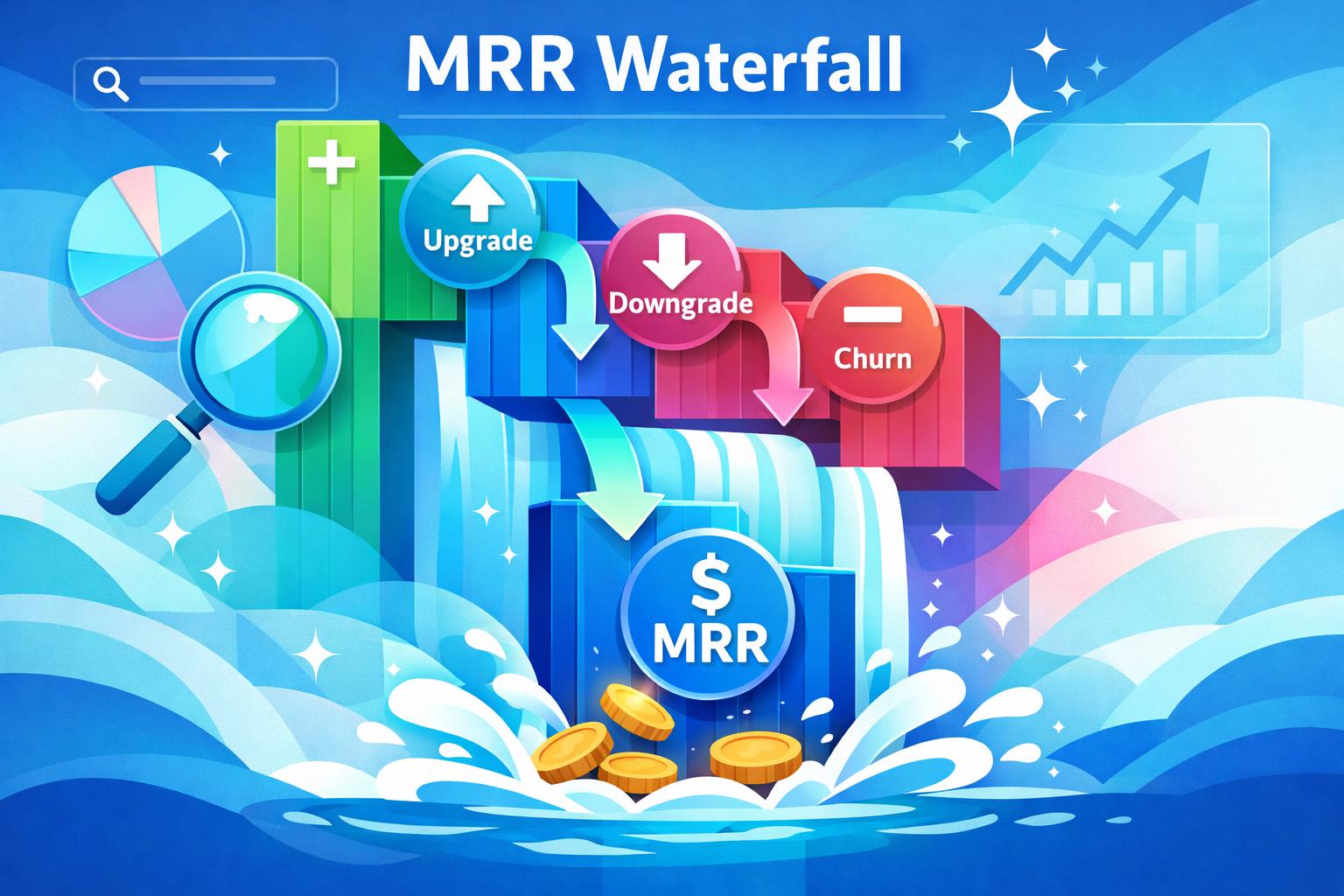
    If you’ve ever looked at your monthly recurring revenue and wondered what’s really driving changes, the MRR waterfall is your roadmap to understanding it. Instead of seeing revenue as a single number, this report breaks down every gain and loss — new subscriptions, upgrades, downgrades, and churn — showing where growth is truly coming from. In this post, you’ll learn how an MRR waterfall works, which components reveal the most about your subscription health, and how to build one you can trust for accurate, actionable insight.

    How the MRR Waterfall Reveals Subscription Dynamics

    At its core, an MRR waterfall shows how your recurring revenue moves from one period to the next by categorizing what’s added, lost, or changed. Starting MRR plus new gains minus losses should equal the closing MRR, giving a clear view of performance drivers. This method highlights which customer actions and behaviors are fueling or slowing growth.

    The standard breakdown typically includes new MRR from new customers, expansion MRR from existing customers upgrading, contraction MRR from downgrades, and churn MRR representing full cancellations. Some businesses also track reactivation MRR to count customers who return after canceling. Together, these categories prevent false optimism by showing whether growth comes from net new revenue or masking steep losses.

    For example, strong new MRR may look good on the surface but could be offset by high churn or contraction. Expansion MRR, on the other hand, is a powerful indicator of product value since it reflects how much existing customers are willing to invest more. Tracking contraction and churn early provides time to address declining engagement before it becomes unrecoverable loss.

    “An accurate MRR waterfall transforms guesswork into clarity by showing not just that revenue changed, but why it changed.”

    When connected to systems like subscription and billing management in MainFoundry, these metrics automatically align with customer and financial data. This allows teams to see MRR changes at both the aggregate and customer levels — turning data from static reports into operational insights.

    Building an MRR Waterfall You Can Trust

    Creating a reliable waterfall starts with clean data. Begin by capturing true monthly recurring revenue snapshots at the start and end of each period. Normalize annual or prepaid contracts into monthly equivalents, and exclude one-time fees to ensure consistency. Once you have those baselines, track every customer-level change precisely by categorizing events correctly — new customer, upgrade, downgrade, or cancellation.

    After categorization, reconcile your data. If starting MRR plus gains minus losses doesn’t equal ending MRR, something is likely missing or misclassified. Common culprits include mid-cycle price adjustments or late updates to cancellations. Visualization is the final and most insightful step, typically using a waterfall chart that visually depicts how each event contributes to the net change in recurring revenue.

    Pro Tip: Tie your MRR data directly to customer accounts in your CRM to identify which accounts are expanding, contracting, or leaving. Platforms like MainFoundry CRM simplify this by linking financial and customer insights in one place.

    When done right, your MRR waterfall becomes more than a finance report — it becomes a growth management tool. Teams can focus conversations around clear levers like reducing churn, improving onboarding for new customers, or promoting expansions through better value realization. For businesses seeking sustainable growth, this level of clarity often matters more than top-line speed alone.

    Key Takeaways

    • An MRR waterfall explains not just how much revenue changed, but why it changed across subscriptions.
    • Expansion and contraction MRR often reveal deeper performance health than new revenue alone.
    • Clean definitions and consistent timing are essential to reconciling MRR accurately.
    • Connecting finance, sales, and customer data inside one system, such as MainFoundry, reduces reporting friction and improves reliability.

    By adopting this structured approach, your revenue tracking goes from reactive reporting to proactive management. Explore how MainFoundry unites subscription analytics and CRM data to make recurring revenue easier to understand and act on, or reach out directly at MainFoundry Contact for tailored guidance.

  • Gross Margin SaaS Benchmarks, COGS, and Valuation

    Gross Margin SaaS Benchmarks, COGS, and Valuation

    If you operate or invest in a SaaS business, understanding gross margin SaaS performance is one of the fastest ways to assess scalability and efficiency. SaaS companies can deliver software repeatedly at low incremental cost, making margins a vital reflection of sustainability. This post unpacks what gross margin really means for SaaS, how to define cost of goods sold (COGS), what typical benchmarks look like, and why small margin shifts can dramatically affect valuation and investor confidence. You’ll also discover how better expense categorization can turn gross margin into a forward-looking management tool rather than a retroactive metric.

    What Gross Margin Means for SaaS Companies

    At its core, gross margin reveals how efficiently a SaaS company delivers its product to customers. The calculation is simple—revenue minus cost of goods sold, divided by revenue—but the meaning depends entirely on what’s included in those costs. For SaaS, gross margin focuses on direct, recurring costs required to deliver the service, excluding broader operating expenses like marketing, R&D, or administrative salaries.

    This distinction helps teams see if the product itself is profitable before layering in growth investments. A healthy margin implies sufficient room to fund innovation and acquisition, while a thin margin can undermine even fast top-line growth. Consistency in how you define and track costs becomes essential to interpreting the story your data tells.

    “A strong SaaS gross margin shows the product engine is efficient and scalable long before sales or marketing investments come into play.”

    Common COGS components include hosting and infrastructure costs such as cloud compute and storage, customer support for existing users, onboarding or implementation services, and any third-party licenses directly tied to software delivery. In contrast, product development or sales-related spend should remain outside COGS to maintain clarity and accuracy. Using consistent definitions turns gross margin from a fuzzy number into a reliable management gauge. Platforms like MainFoundry make this easier by enabling precise categorization between revenue, hosting, and customer support expenses.

    Gross Margin Benchmarks and Valuation Impact

    SaaS businesses are prized for their strong margins, especially as they scale. Once the product is built, serving additional customers costs little, which is what makes the model so powerful. Industry-wide, gross margins between 70 and 85 percent are generally considered healthy, with mature or enterprise-focused companies often surpassing 80 percent. Early-stage SaaS may temporarily sit below this range as onboarding and infrastructure investments scale, but improving over time signals operational strength.

    From an investor’s perspective, gross margin drives confidence in scalability. High-margin SaaS models can self-fund growth, making them appealing during fundraising or acquisition. Conversely, low margins increase risk, implying that delivering the product consumes too much revenue. Investors must then question pricing, cost structure, or long-term profitability. Tracking margin trends monthly—or through trailing averages—helps reveal progress and risks early.

    SaaS companies with gross margins above 80% often command premium valuations because they scale faster with less incremental cost.

    Operational leaders should treat gross margin as more than a snapshot metric. When margins expand, it validates efficiency improvements such as automation or better onboarding. When they compress, it’s a sign to review pricing, vendor contracts, or support processes. Tools like MainFoundry’s connected CRM and billing environment simplify this by tying revenue, customer segments, and expense data together. That visibility helps identify which cohorts or plans drive the healthiest economics.

    Key Takeaways

    • Gross margin measures delivery efficiency by isolating revenue minus direct product costs, not overall profitability.
    • SaaS COGS should include only customer-scaling costs such as hosting, support, and onboarding—not R&D or marketing spend.
    • Healthy benchmarks range between 70% and 85%, with industry leaders often exceeding 80% as they mature.
    • Because investors tie gross margin directly to valuation, maintaining strong margins signals resilience and efficiency.
    • Unified financial and CRM platforms bring visibility, turning gross margin into a tool for proactive decision-making.

    Related Reading

    Explore SaaS Valuation Metrics: ARR, Retention, and Efficiency Ratios to learn more about how investors evaluate SaaS performance.