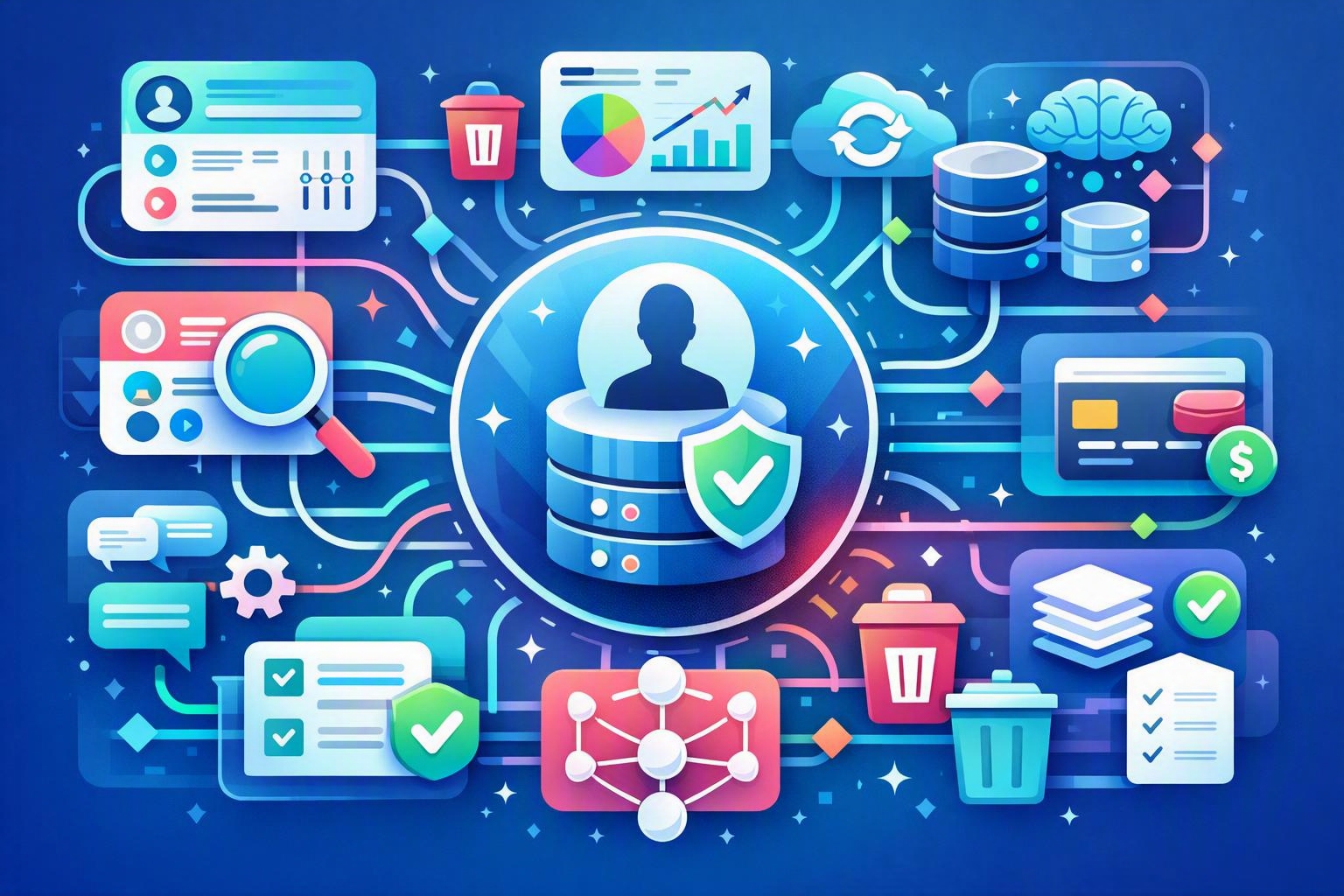
Handling data deletion requests in SaaS environments has become a core operational responsibility rather than a narrow legal exercise. Under GDPR and similar privacy regulations, organizations must be able to identify, assess, erase, anonymize, or retain customer data across interconnected systems without creating compliance gaps or operational risk. The challenge is that customer information rarely stays in one place. It spreads across databases, billing tools, analytics platforms, support systems, backups, search indexes, and third-party integrations.
This guide explains how SaaS companies can build practical, GDPR-compliant deletion workflows that support auditability, technical orchestration, and legal review. It also explores how platforms like MainFoundry simplify privacy operations through centralized workflows, unified data relationships, and connected operational systems.
Building a GDPR-Compliant Deletion Workflow
Many SaaS companies make the mistake of treating right-to-erasure requests as isolated support tickets. In reality, GDPR compliance requires a structured workflow that spans engineering, legal, finance, security, and customer operations. A successful process starts with a complete data inventory that maps every category of personal data to the systems where it exists.
Customer information often appears across production databases, analytics pipelines, support tooling, exports, archived backups, and collaboration platforms. Teams should document whether each system supports hard deletion, anonymization, or limited retention because of financial or legal obligations. Centralized platforms simplify this process considerably. For example, MainFoundry’s integrated architecture across its CRM and customer management tools, marketing analytics platform, and subscription and billing workflows provides a more unified view of customer records across business operations.
A “delete user” button is rarely enough. Effective GDPR compliance depends on orchestration across every connected system that stores or derives personal data.
Once the inventory exists, organizations should establish a structured deletion lifecycle that includes intake, identity verification, legal assessment, technical execution, verification, and confirmation. Identity verification is especially important because companies must avoid deleting or exposing records for the wrong individual. In practice, this often means tying requests to authenticated sessions, verified email ownership, or additional review for sensitive data.
Legal assessment introduces another layer of complexity. Some data categories can be deleted immediately, while others require retention because of accounting regulations, fraud prevention obligations, or contractual requirements. Mature SaaS workflows typically separate records into three categories: data eligible for hard deletion, data suitable for anonymization or pseudonymization, and records that must remain retained under policy controls.
“The goal of GDPR deletion workflows is not indiscriminate removal but policy-driven handling of each category of customer data.”
Technical execution should also extend beyond primary databases. Modern SaaS systems include asynchronous services, search indexes, cache layers, reporting exports, analytics warehouses, and downstream integrations. Many engineering teams solve this by using a centralized orchestration layer that coordinates deletion tasks across systems while allowing each service to manage its own records independently.
Derived systems require dedicated handling because deleted records may still appear in analytics reports, search indexes, or monitoring tools. Warehouses often process erasure requests in scheduled cleanup jobs, while search systems may require reindexing or document removal. Cache layers also need invalidation rules to prevent deleted content from resurfacing temporarily.
Pro Tip: Treat deletion requests as durable operational records. If backups are restored after a disaster recovery event, deletion workflows should automatically replay against restored systems before they return to production.
Backups create additional complexity because archived snapshots usually cannot be modified immediately. Most organizations instead adopt a “beyond use” approach in which deleted records remain inaccessible inside backups and are removed automatically if restored systems ever become active again.
How MainFoundry Supports Compliant Data Deletion
Privacy compliance becomes significantly easier when deletion handling is built directly into platform architecture. MainFoundry follows privacy-by-design principles through centralized workflows, shared identifiers, and connected operational records that reduce fragmentation across customer systems.
One major advantage is unified identity management. Fragmented SaaS environments often duplicate customer records across independent tools with mismatched identifiers, making complete deletion difficult to verify. MainFoundry reduces this problem by connecting customer operations, marketing activity, workflows, and financial records through consistent data structures that make relationships easier to trace.
The platform’s business workspaces and linked operational records also support more accurate cascade deletion handling. Since entries across workflows, CRM objects, operational records, and tasks remain connected through shared identifiers, teams can scope deletion requests without affecting unrelated tenant data.
Additionally, MainFoundry’s AI-powered business automation platform helps operational teams search records, summarize deletion scope, identify linked entities, and review affected systems before irreversible actions occur. This becomes especially valuable in enterprise SaaS environments where deletion requests may span multiple teams or workspaces.
Auditability and observability remain equally important. Mature deletion systems should be idempotent, meaning requests can safely retry if temporary failures occur. They should also expose statuses such as received, verified, in progress, completed, or escalated so administrators can monitor execution across asynchronous systems.
Third-party processors add another operational layer because GDPR obligations extend beyond internal systems. SaaS companies often depend on vendors for payments, analytics, communication, support, and infrastructure monitoring. Maintaining a processor registry that maps vendors to the data categories they handle makes deletion coordination more reliable and easier to automate.
Finally, organizations should continuously test deletion workflows instead of assuming they work correctly after initial implementation. New integrations, schema updates, and evolving analytics pipelines frequently introduce unnoticed retention paths over time. The most reliable SaaS teams validate workflows regularly using synthetic users and controlled datasets to ensure data disappears appropriately across production systems, derived datasets, customer-facing interfaces, and backups.
Key Takeaways
- GDPR-compliant deletion depends on accurate data inventories, identity verification, legal review, and coordinated execution across systems.
- Derived systems such as analytics warehouses, search indexes, cache layers, and backups require dedicated deletion handling strategies.
- Centralized architectures simplify cascade deletion, improve auditability, and reduce fragmented data risks across SaaS operations.
- MainFoundry supports compliant workflows through unified records, AI-assisted operational tooling, connected workspaces, and centralized visibility.
Organizations that approach data deletion as an engineering and operational capability rather than a simple support task are better positioned to scale privacy compliance confidently. To learn more about how MainFoundry supports customer operations, compliance workflows, and business data management, visit https://www.mainfoundry.com or contact the team at https://www.mainfoundry.com/contact.
Related Reading
Explore MainFoundry’s CRM and customer management tools and marketing analytics platform to see how unified operational systems improve privacy visibility and governance.