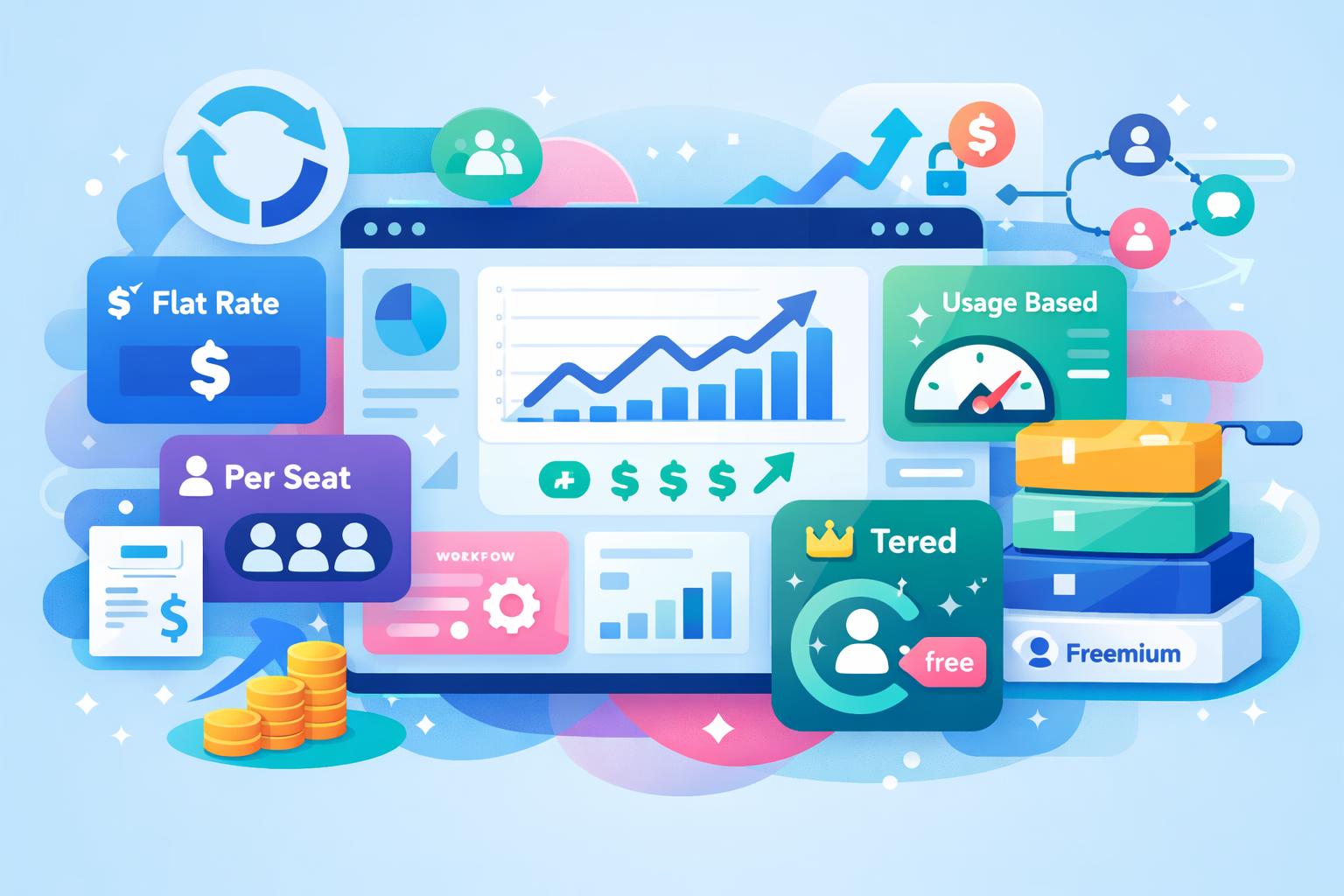
Choosing the right SaaS pricing models can influence far more than monthly revenue. Pricing affects how customers evaluate your product, how quickly sales cycles move, and whether expansion revenue grows naturally over time. Many SaaS companies begin with simple subscription structures, then evolve toward hybrid approaches as they learn more about customer behavior and operational costs.
This guide explains the five most common SaaS pricing models, including flat-rate, per-seat, usage-based, tiered, and freemium pricing. You will also learn how each model impacts metrics such as ARPU, churn, CAC payback, and net revenue retention. Additionally, the article explores why flexible systems like MainFoundry’s subscription and billing tools are becoming increasingly important for scaling SaaS businesses.
How the Main SaaS Pricing Models Work
Flat-rate pricing remains one of the simplest subscription structures available. Customers pay a recurring fee for product access with minimal restrictions, making the value proposition easy to understand. This approach often works well for early-stage products validating demand or niche software with predictable usage patterns. However, expansion potential becomes limited when heavy users consume significantly more resources without increasing revenue.
In contrast, per-seat pricing connects revenue directly to user growth. Collaboration software, CRM platforms, and project management tools commonly use this structure because adoption typically spreads across teams over time. As organizations add employees, subscription revenue expands naturally. Some companies reduce friction further with per-active-user billing, where customers only pay for users who actively engage during the billing cycle.
“Modern SaaS businesses rarely rely on a single pricing model forever. Hybrid pricing has become the standard for sustainable growth.”
Usage-based pricing, sometimes called consumption pricing, ties cost directly to activity such as API calls, transactions, storage, or messages sent. Infrastructure and developer-focused products often benefit from this structure because spending scales alongside customer success. While this model lowers barriers to entry and creates strong expansion opportunities, customers may become cautious if billing feels unpredictable.
Tiered pricing introduces multiple packages for different customer segments, including plans such as Starter, Growth, and Enterprise. In practice, tiered structures usually complement another pricing model rather than replacing it. Effective packaging creates clear upgrade paths, while poor tier design can create unnecessary confusion and pricing friction.
Freemium pricing supports product-led growth by offering limited free access before monetization. Collaboration and productivity platforms frequently succeed with this strategy because users can experience value quickly and invite others into the platform. However, sustainable freemium models require clear upgrade triggers and manageable infrastructure costs.
Pro Tip: Hybrid pricing structures often outperform single-model strategies because they align monetization with multiple customer segments and usage patterns.
As SaaS businesses evolve, flexible billing systems become increasingly important. MainFoundry’s billing and finance management tools help companies configure hybrid pricing without rebuilding subscription infrastructure from scratch. Teams can connect recurring billing, revenue tracking, and financial reporting into a single operational workflow.
How SaaS Pricing Models Influence Growth Metrics
Pricing strategy directly shapes the metrics investors and operators monitor most closely. A model optimized for rapid customer acquisition may reduce expansion revenue, while aggressive monetization can increase churn if customers perceive pricing as unfair. The strongest pricing structures balance growth, predictability, and customer trust.
- ARPU and expansion revenue often improve with per-seat and usage-based pricing because customer spending increases alongside growth.
- CAC payback typically improves when pricing remains simple and easy for buyers to understand during sales cycles.
- Net revenue retention benefits from upgrade paths, feature tiers, and usage-driven expansion opportunities.
- Churn behavior varies by pricing structure, including seat reductions in per-user models and cost optimization in consumption-based products.
Beyond metrics, pricing also shapes customer psychology. Flat-rate pricing creates predictability and budget confidence, while usage-based pricing aligns spending more closely with measurable value delivered. Freemium models encourage experimentation, especially when upgrade paths feel intuitive rather than restrictive.
The best SaaS pricing strategies evolve alongside customer behavior, product adoption, and revenue goals.
Different customer segments often respond to different monetization approaches. Enterprise buyers may prefer predictable subscriptions and committed contracts, while smaller customers favor low-friction usage-based entry points. This creates a strong case for flexible pricing infrastructure that supports experimentation without operational disruption.
MainFoundry supports these evolving requirements by helping businesses test pricing changes, launch feature-based tiers, and combine subscription billing with consumption-based pricing. Teams can also connect pricing performance to marketing analytics and attribution reporting to understand how pricing impacts acquisition and retention across channels.
As revenue scales, centralized pricing visibility becomes increasingly valuable. Monitoring seat expansion, upgrade behavior, and churn patterns in one system helps operators identify what is truly driving sustainable growth. Combined with unified CRM and customer management, pricing data becomes part of a broader operational strategy rather than an isolated finance task.
Key Takeaways
The most effective SaaS pricing models align directly with how customers experience value. Collaboration products often benefit from per-seat pricing, infrastructure tools commonly succeed with usage-based billing, and product-led growth companies frequently combine freemium access with tiered upgrades.
Sustainable pricing strategies should remain flexible as your market evolves. Businesses that continuously refine packaging, limits, and monetization structures are often better positioned to improve retention, increase ARPU, and strengthen net revenue retention over time.
If your company is evaluating subscription models, hybrid billing structures, or usage-based monetization, explore how MainFoundry helps businesses manage pricing, finance, and customer operations within one connected platform at https://www.mainfoundry.com.
Related Reading
Learn more about optimizing subscription operations with billing and finance management tools designed for growing SaaS companies.