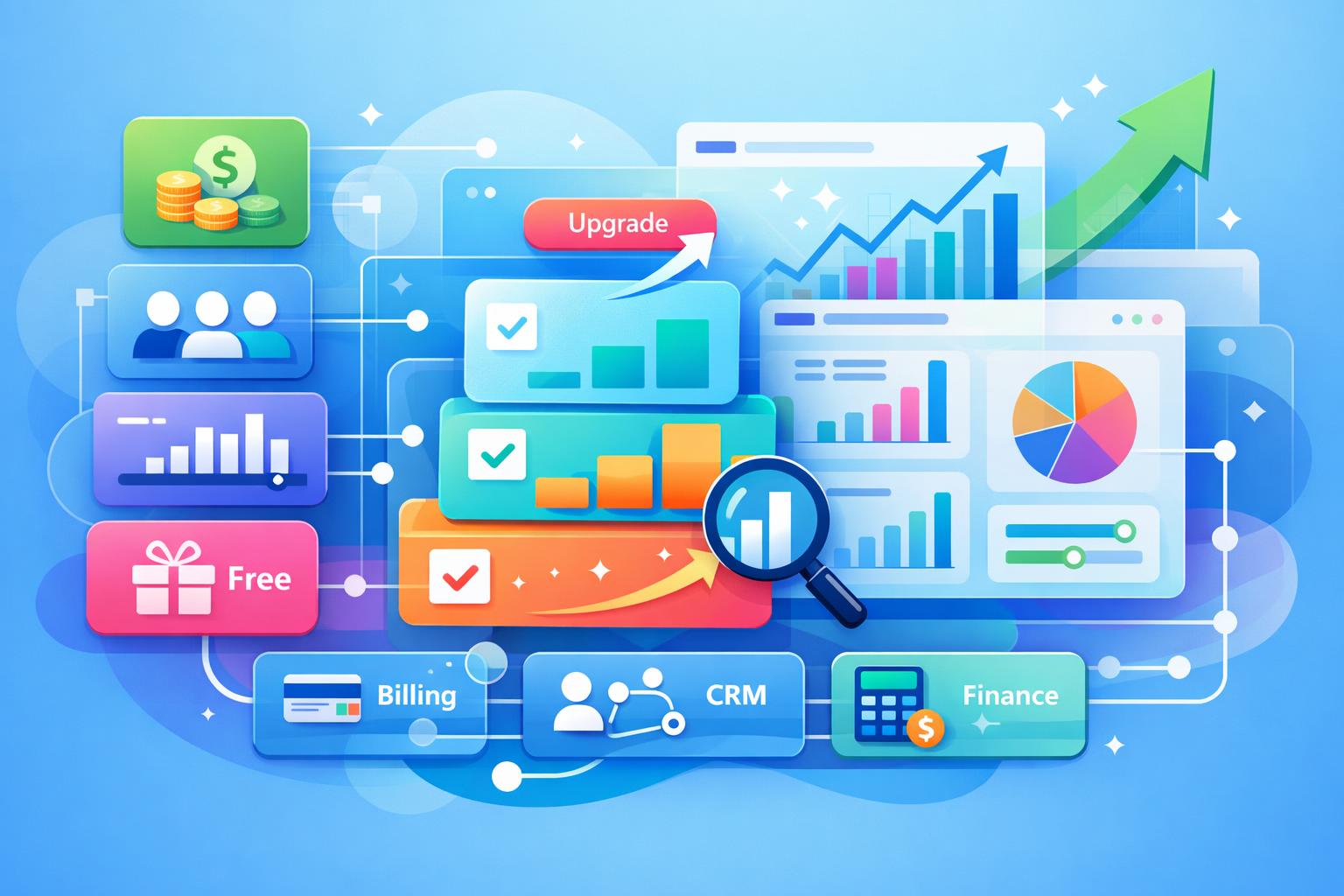
Choosing the right SaaS pricing model affects far more than your monthly recurring revenue. Pricing shapes how customers perceive value, how easily they adopt your product, and whether expansion revenue becomes predictable over time. A pricing structure that aligns with customer outcomes can accelerate growth, while a poorly designed model often creates friction that limits retention and scalability.
This guide explains the most common SaaS pricing approaches, including flat-rate, per-seat, usage-based, tiered, and freemium models. You’ll also see how operational systems influence pricing flexibility and why platforms such as MainFoundry help SaaS companies manage subscriptions, analytics, and billing workflows without adding unnecessary complexity.
How Pricing Models Drive SaaS Revenue Growth
Every pricing structure creates a different growth dynamic. Some models rely heavily on acquiring new customers, while others naturally increase revenue as customers expand usage, onboard more employees, or adopt advanced capabilities. Understanding these tradeoffs helps you align pricing with long-term business strategy.
Flat-rate pricing remains one of the simplest approaches because customers pay one recurring fee regardless of usage or team size. This structure works well for products where access itself represents the core value, including research databases, compliance platforms, and niche industry software. Buyers often appreciate the clarity because budgeting becomes straightforward and purchasing decisions move faster.
However, flat-rate pricing can limit expansion opportunities. Heavy users may consume significantly more resources without paying more, while lighter customers may question whether the cost reflects their actual usage. SaaS businesses using this model often depend heavily on new customer acquisition for growth. Operational visibility becomes essential, which is why tools like subscription and billing management systems help track retention trends, recurring revenue, and customer profitability over time.
“The strongest SaaS pricing structures align revenue growth with how customers experience value.”
Per-seat pricing takes a different path by charging based on the number of licensed users. Collaborative software products, including CRMs, communication platforms, and project management tools, frequently use this structure because value increases as more employees adopt the product. A customer may begin with a small team and gradually expand usage across multiple departments, creating a natural expansion revenue engine.
Additionally, seat growth often provides early operational signals about customer health. Shrinking license counts may indicate churn risk before cancellation occurs, while expanding usage usually reflects stronger product adoption. Still, this model can become less effective when customer outcomes depend more on automation, infrastructure processing, or API activity than individual users.
Pricing is not just a billing decision. It directly shapes retention, expansion revenue, and customer behavior.
Usage-based pricing, also called consumption pricing, has become increasingly common among API platforms, AI products, analytics services, and infrastructure providers. Instead of charging per user, companies bill customers according to measurable activity, including API calls, storage consumption, generated outputs, or processing volume. This creates strong alignment between customer success and revenue growth because spending increases naturally alongside product adoption.
The challenge with consumption pricing is predictability. Revenue can fluctuate significantly when customer usage patterns vary month to month, and buyers may hesitate if pricing feels difficult to estimate. Accurate measurement, transparent invoicing, and real-time visibility become essential. Platforms with integrated finance management capabilities help SaaS companies handle recurring invoicing, usage tracking, and flexible subscription logic more effectively.
Tiered and Freemium Pricing for Scalable Expansion
Tiered pricing introduces structured packages designed for different customer segments. SaaS businesses typically offer entry-level, professional, and enterprise plans with varying feature sets, limits, or support levels. Smaller businesses can access core functionality at lower costs, while larger organizations gain advanced integrations, reporting capabilities, compliance tools, and dedicated support.
One reason tiered pricing works so well is that it creates clear upgrade paths. Customers can start with affordable plans and move upward as operational complexity increases. However, overly complicated tiers often slow conversions because buyers struggle to understand feature boundaries. Strong tier structures keep differences obvious and tied directly to customer outcomes.
Pro Tip: Pricing tiers perform best when each upgrade solves a meaningful operational problem rather than simply unlocking random features.
Freemium models focus primarily on customer acquisition by offering limited free access before requiring payment for advanced capabilities or higher usage limits. This structure can dramatically increase top-of-funnel growth because users experience the product before making a financial commitment. Self-serve SaaS businesses often use freemium strategies to reduce acquisition costs and accelerate adoption.
Successful freemium products carefully balance accessibility with conversion incentives. Free users still generate infrastructure and support costs, so companies typically reserve collaboration features, advanced analytics, or higher activity thresholds for paid plans. Businesses that connect product analytics with customer and billing data can identify product-qualified leads more effectively through systems like CRM and customer management tools and marketing analytics platforms.
In reality, many SaaS companies combine several pricing approaches together. A collaboration product may use tiered plans with per-seat billing inside each package, while an AI platform may charge a flat subscription fee plus consumption-based API costs. As these combinations evolve, operational flexibility becomes increasingly important.
Modern SaaS operations require systems capable of managing changing pricing logic, subscription adjustments, customer segmentation, and analytics simultaneously. Flexible tools such as custom business workspaces help teams connect finance, CRM, marketing, and workflow automation in a single operational environment.
Key Takeaways
- Flat-rate pricing offers simplicity but may limit expansion revenue opportunities over time.
- Per-seat and usage-based pricing naturally support scalable revenue growth when aligned with customer value.
- Tiered and freemium models help SaaS companies serve multiple customer segments while creating structured upgrade paths.
- Flexible operational infrastructure is essential for managing hybrid pricing, subscription changes, and revenue analytics efficiently.
SaaS pricing should evolve alongside your product and customer base. Businesses that consistently monitor plan adoption, upgrade behavior, usage trends, and churn indicators are better positioned to refine pricing decisions quickly. If your team needs more adaptable workflows for subscriptions, analytics, and billing operations, explore MainFoundry’s platform capabilities at https://www.mainfoundry.com or learn more about tailored operational workflows at https://www.mainfoundry.com/contact.
Related Reading
Learn more about optimizing recurring revenue operations with subscription and billing management tools designed for modern SaaS businesses.