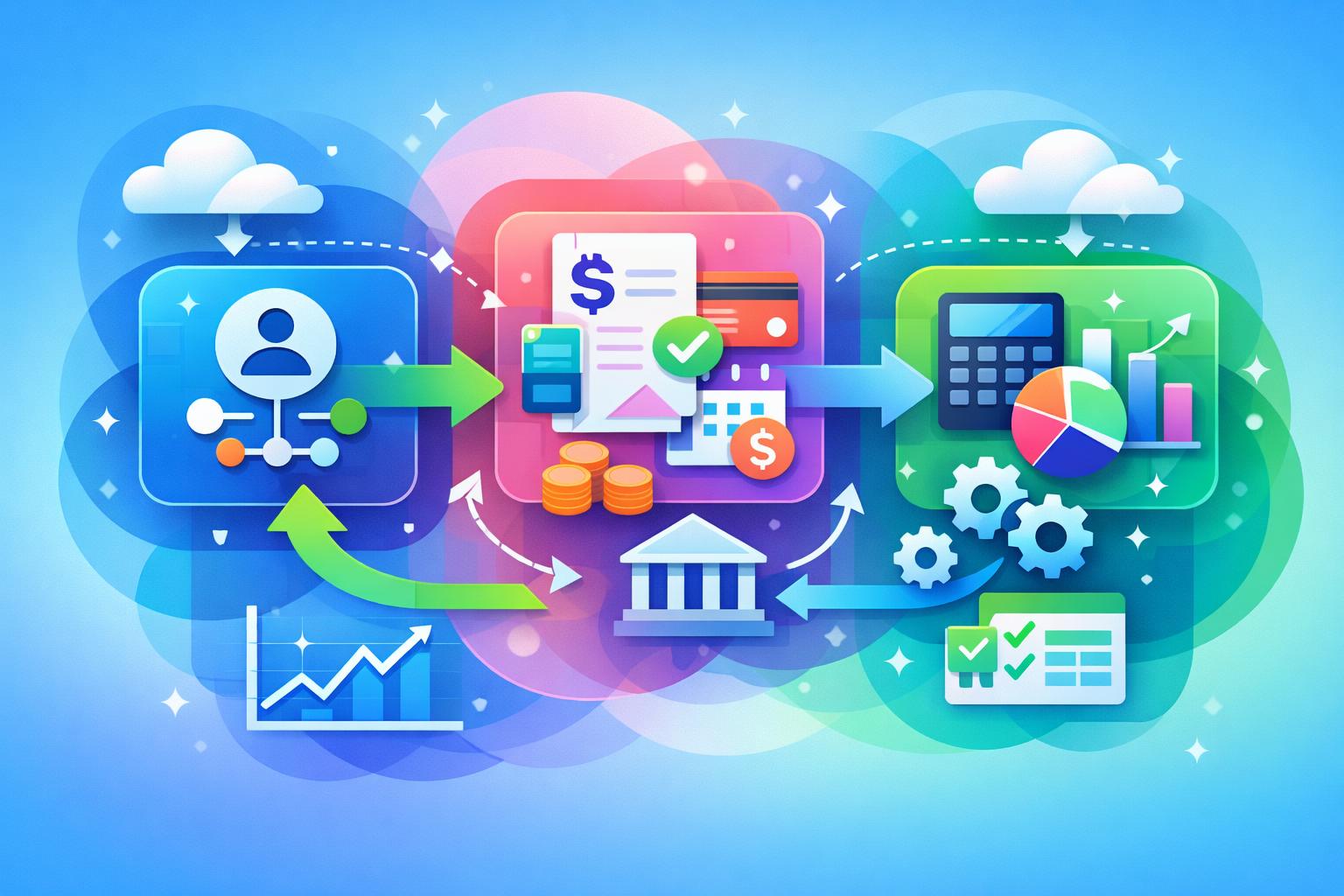
If your SaaS company has grown beyond a handful of customers, chances are your bookkeeping has become tangled in spreadsheets and manual reconciliation checks. What starts simple—exporting a few Stripe invoices—can quickly evolve into hours of data entry and late-night fixes. This post explains how to automate bookkeeping for SaaS companies so you can scale financial operations without adding headcount. You’ll learn how integrated workflows tie billing, CRM, and accounting together, delivering accuracy and speed across invoices, payments, expenses, and month-end closes.
Why SaaS bookkeeping needs automation
Unlike traditional business models, SaaS revenue recognition stretches over months or years. Customers pay monthly or annually, usage-based fees fluctuate, and upgrades or downgrades constantly alter revenue timing. When this complexity meets manual bookkeeping, the process collapses into mismatched invoices, uncertain revenue schedules, and unreliable reports.
Automation solves these problems by connecting systems. When your MainFoundry workspace unifies CRM, billing, and finance data, your accounting platform—like e-conomic—receives structured entries automatically. This means invoices, payments, and expenses are cleanly synced across systems, removing multiple manual steps from your monthly close.
“Automation isn’t about flashy technology—it’s about creating dependable financial operations that scale with your SaaS growth.”
How to automate core SaaS bookkeeping workflows
The most impactful automation begins with your invoicing and payment workflows. When invoices are generated directly from active subscriptions and sent automatically into your accounting platform, each record reflects current customer and contract data. With systems like MainFoundry bridging your CRM and e-conomic integration, you ensure the right mappings and dates are applied, minimizing errors and end-of-month fixes.
Payment matching is another area that eats up time when done manually. Automation uses invoice references and identifiers to reconcile payments automatically. When data consistency is maintained across systems, transactions line up perfectly—removing guesswork and freeing your finance team to focus on analysis instead of matching tasks. The same logic extends to expense categorization, where consistent rules help prevent reporting noise and maintain cleaner ledgers.
Pro Tip: Use automation rules to tag vendor expenses once, then apply those rules system-wide. This keeps bookkeeping uniform without repetitive manual entry.
Finally, month-end reconciliation benefits from repeatable logic rather than reinventing the process each cycle. Automated journal entries and revenue schedules mean your team spends more time reviewing data than rebuilding spreadsheets. With systems unified under MainFoundry, closing the books becomes confirmation—not correction.
- Subscription data drives invoice creation without manual edits
- Payments and invoices reconcile automatically using shared identifiers
- Expense categorization stays consistent with vendor-based rules
- Month-end close becomes a streamlined review process
Key Takeaways
Automating bookkeeping is less about replacing your accounting platform and more about improving what feeds it. By connecting operational and billing data directly to finance systems, SaaS teams gain both efficiency and trust in their numbers. Start by integrating CRM and subscription workflows with MainFoundry and see how unified operations streamline every part of your close cycle. If your finance team is still manually reconciling transactions, it’s time to move toward a connected workflow that scales effortlessly.
Related Reading
Explore how unified automation workflows simplify SaaS finance to learn more about connecting operations and accounting effectively.