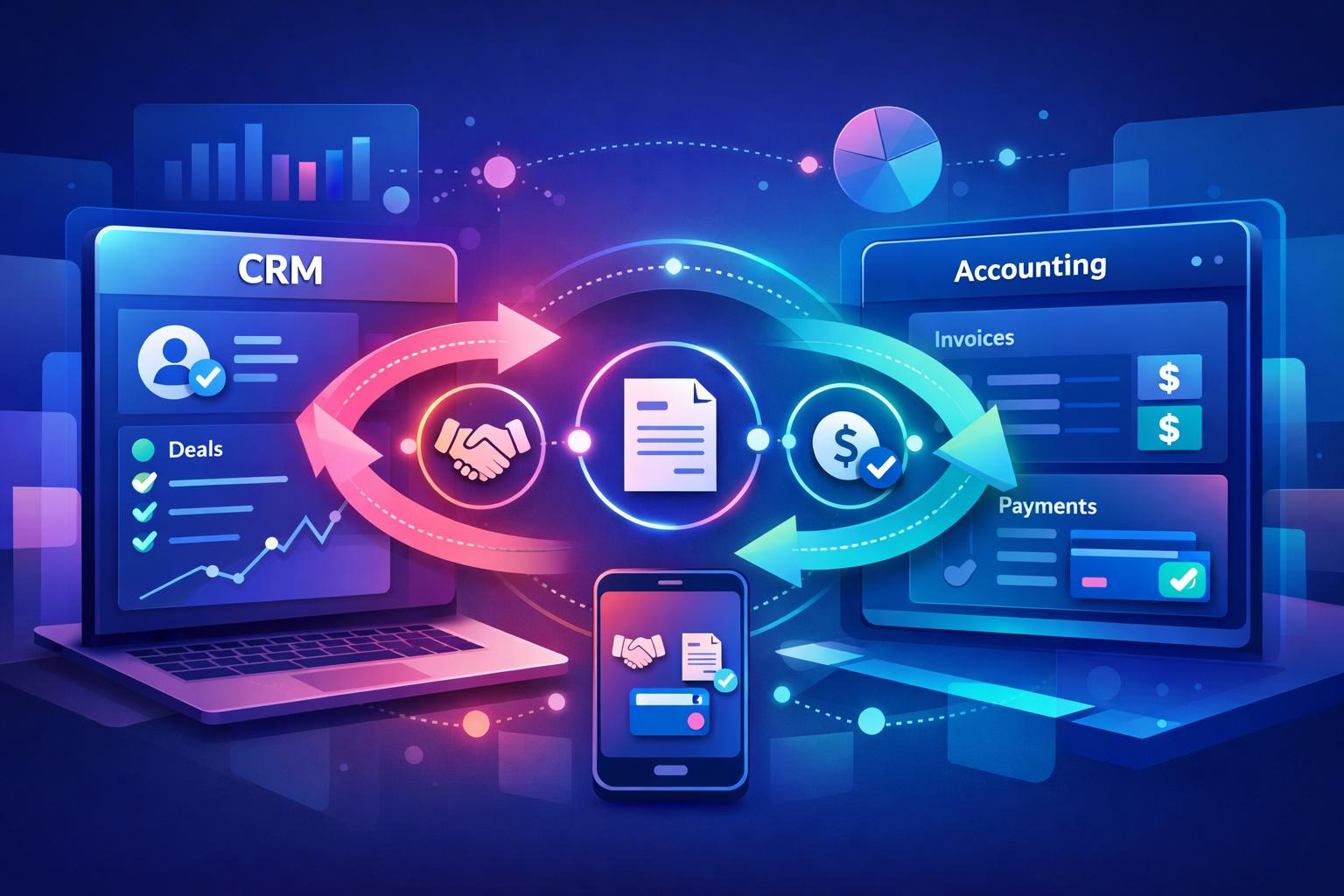
When growing businesses try to align sales and finance, the disconnect between CRM and accounting software can quickly turn into chaos—missing payments, unmatched invoices, endless spreadsheets. This guide shows how to connect CRM to accounting software effectively, blending structured data flows with automation that keeps every deal, invoice, and payment in sync. You’ll learn how the MainFoundry integration with e-conomic creates a single, reliable process for managing customer data, automating invoices, and reconciling payments, without disrupting existing financial workflows.
Choosing the Right Way to Connect CRM to Accounting Software
Before linking your systems, determine how they should interact. Native integrations are usually the most stable method since they manage sensitive financial data without demanding heavy upkeep. Third-party connectors work for short-term needs but often introduce latency and limited accounting logic control. For businesses with specific requirements, custom API solutions offer complete flexibility, though they demand technical oversight and testing.
Platforms like MainFoundry’s CRM approach the connection with simplicity and control. Customer and company details become the single source of truth within the CRM, while billing and revenue information are centralized where finance teams already operate. The e-conomic integration syncs structured data instead of raw logs, minimizing mismatches and speeding up reconciliation. Once the method is chosen, the critical step becomes modeling your data accurately.
Mapping your chart of accounts ensures every closed deal in the CRM hits the appropriate income account in e-conomic. Instead of pushing undifferentiated amounts, MainFoundry lets you associate particular deal types or product categories with the right ledger entries. That means when invoices are generated automatically, accounting classifications already reflect the business reality.
“Smart integrations don’t just move data—they enforce structure, accuracy, and trust across your revenue operations.”
When a deal status changes to “won,” invoice automation activates within the billing and subscription management module. Line items, taxes, and customers sync into e-conomic automatically, avoiding any duplication between teams. When payments post back from e-conomic, MainFoundry updates the CRM’s corresponding records, giving real-time visibility into every transaction and removing the need for endless spreadsheets or manual follow-up.
Maintaining Clean Data and Audit Trails Over Time
Once connected, the true value of the integration lies in data integrity and visibility. A well-governed link between CRM and accounting platforms provides full auditability. In MainFoundry, every significant update—invoice creation, status change, or payment reflection—is timestamped under the relevant contact and company record. This historical transparency simplifies internal reviews and satisfies compliance checks effortlessly.
To ensure ongoing accuracy as your business scales, apply a few non-negotiable principles. Each data element must have ownership, such as customer identities managed in the CRM and financial postings stored only within accounting. Always test structural adjustments—like mapping updates or tax rule changes—on a small scale first. Cross-train sales and finance on the automation triggers versus manual checkpoints, and frequently review sync logs to prevent minor discrepancies from compounding.
- Respect data ownership boundaries to prevent conflicting updates.
- Vet configuration changes with sample records before deployment.
- Educate teams on what automation handles—and what it doesn’t.
- Monitor sync logs routinely to catch early anomalies.
Beyond invoices, MainFoundry’s custom workspaces can track contract approvals, revenue recognition notes, and collaborative exceptions—all linked directly to financial records. Its integrated security framework guarantees that only authorized personnel access billing data while still supporting role-based collaboration.
Pro Tip: Regularly schedule validation runs comparing CRM and accounting balances—small adjustments early prevent major reconciliation headaches later.
Key Takeaways
The strongest CRM–accounting connections rely on clarity and automation, not complexity. Keep ownership distinct, map data intelligently, and let integrations handle repetitive tasks so teams can focus on decision-making rather than data entry. When configured well, tools like MainFoundry transform revenue management into a single, verified process—from pipeline to payment—without breaking the financial flow.
- Start with native or secure integrations before pursuing custom API work.
- Map CRM deal categories directly to accounting ledgers.
- Automate invoicing and reconciliation to eliminate double entry.
- Maintain governance and monitor logs to ensure data trustworthiness.
To explore further, review your current deal-to-invoice process and spot where manual handoffs still exist. Learn more about how MainFoundry unifies CRM and finance at mainfoundry.com or connect with their team at mainfoundry.com/contact.