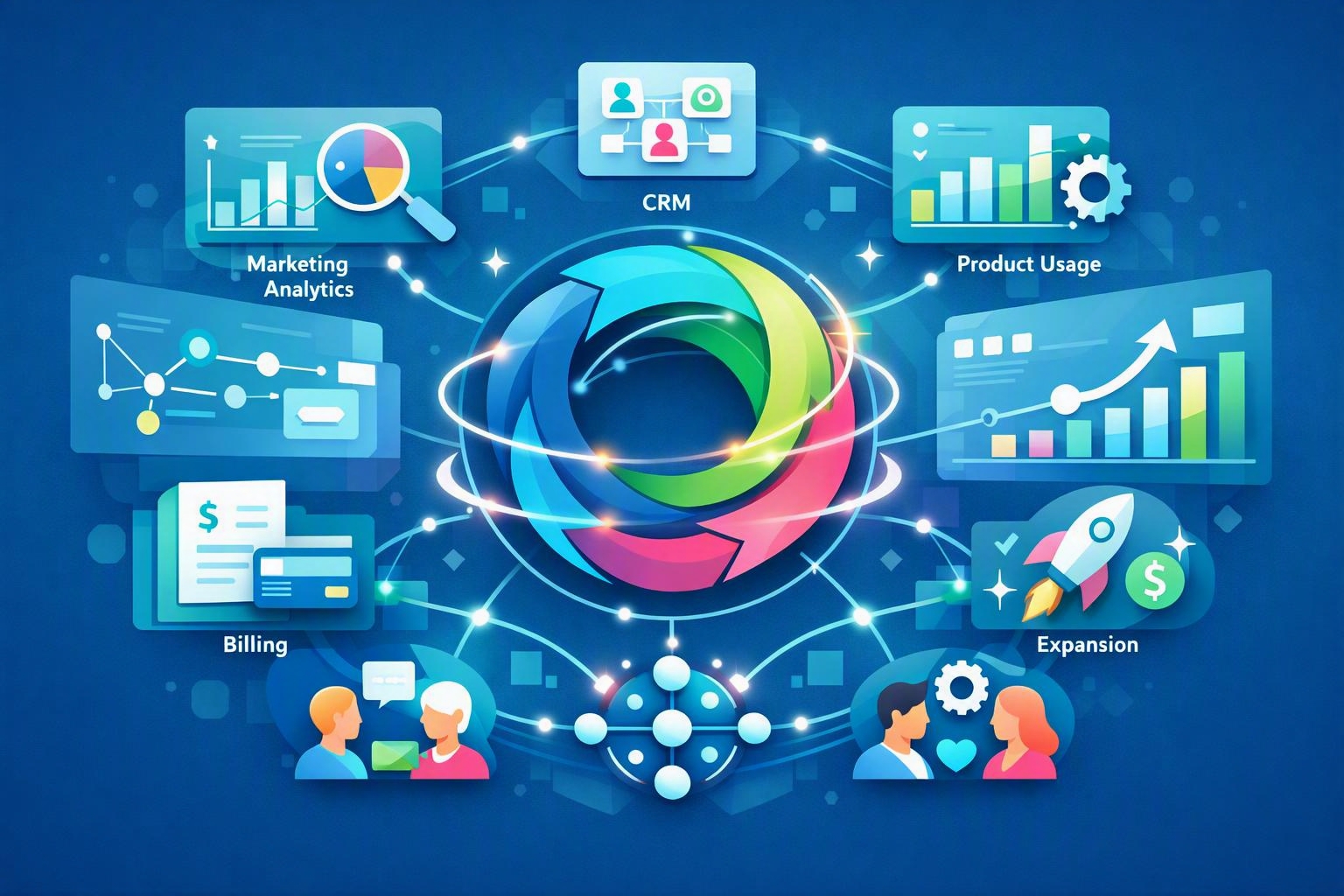
The SaaS flywheel has reshaped how modern software companies think about growth because it reflects how recurring revenue businesses actually scale. Instead of viewing customer acquisition as the endpoint, the flywheel turns every customer interaction into momentum that fuels retention, expansion, and future acquisition. Product adoption strengthens customer success, satisfied customers create referrals, and expansion revenue improves acquisition efficiency over time.
However, the flywheel only works when every team operates from the same customer reality. If marketing, sales, product, finance, and customer success all manage disconnected systems and inconsistent data, growth slows down instead of compounding. This article explains how the SaaS flywheel creates sustainable growth, why unified operational data matters, and how connected business platforms help teams keep momentum moving across the entire customer lifecycle.
How the SaaS Flywheel Drives Compounding Growth
Traditional SaaS funnels are linear. Marketing generates leads, sales closes opportunities, and customers move to support or customer success after the contract is signed. In contrast, the flywheel treats existing customers as an active part of the acquisition engine through renewals, upgrades, advocacy, and referrals. Every successful customer interaction creates momentum that lowers friction for future growth.
Product sits at the center of this model because customer experience determines whether momentum accelerates or stalls. Faster onboarding, intuitive workflows, and strong time-to-value improve activation rates early in the lifecycle. Additionally, companies increasingly use product engagement data, including onboarding completion and usage depth, to identify which accounts are likely to convert, expand, or churn.
“The SaaS flywheel compounds because every positive customer outcome increases the likelihood of future growth.”
Marketing also changes significantly in a flywheel environment. Instead of optimizing only for lead volume, teams focus on attracting customers who are most likely to succeed long term. For example, if webinar attendees consistently adopt key features faster than paid search leads, marketers can shift investment toward channels producing stronger retention and expansion outcomes.
Sales teams increasingly prioritize long-term account growth over one-time deal closure. Product-qualified accounts often provide more reliable buying intent than traditional form submissions because real usage behavior reveals stronger purchase signals. When sales teams can access acquisition history, engagement trends, product usage, and renewal timelines through a shared unified CRM platform, outreach becomes more relevant and forecasting becomes more accurate.
Growth becomes more efficient when customer success, product usage, and acquisition data reinforce one another instead of operating in silos.
Customer success ultimately keeps the wheel spinning. Retention and expansion opportunities often appear through operational signals long before renewal conversations begin. For instance, teams hitting usage limits or adopting advanced workflows may already be expansion-ready months before their contract renewal date. The flywheel compounds because better acquisition targeting improves activation, stronger activation increases retention, and retention generates advocacy that strengthens future acquisition efficiency.
Why Unified Data Determines Whether the Flywheel Works
Many SaaS companies understand the flywheel concept but struggle to operationalize it because customer data remains fragmented across departments. Marketing may track attribution in one platform while product teams monitor usage elsewhere and finance manages subscription data separately. As a result, teams work with conflicting definitions, disconnected workflows, and incomplete customer visibility.
Unified customer visibility changes how every team operates because operational, behavioral, and commercial data all connect into a shared system. Instead of relying on isolated records, teams can access continuously updated customer profiles that include engagement history, billing activity, support interactions, account health, and product usage. This alignment improves coordination across marketing, sales, finance, and customer success.
Pro Tip: SaaS companies often improve retention faster by connecting existing operational systems before adding new tools. Shared visibility creates stronger lifecycle coordination than isolated automation alone.
Operational improvements become easier once every department works from the same source of truth. Product teams can identify onboarding paths tied to stronger retention outcomes, while marketing teams can evaluate which campaigns generate customers with higher expansion potential rather than simply higher conversion volume. Customer success can also intervene earlier when engagement declines before churn risk escalates.
- Faster identification of expansion opportunities through combined product, engagement, and billing signals
- More accurate attribution between acquisition channels and long-term revenue outcomes
- Earlier churn detection based on behavioral and commercial trends across the customer lifecycle
- Improved forecasting and lifecycle automation tied directly to customer activity
This is why unified business platforms have become increasingly important for SaaS operations. Platforms like MainFoundry connect CRM, finance operations, marketing analytics, and operational workflows into one environment rather than forcing teams to manually stitch together disconnected systems. Through marketing analytics and attribution tracking, companies can connect campaigns directly to retention and expansion outcomes.
Finance visibility also plays a critical role because subscription changes, invoice history, and renewal timing directly influence customer health. With subscription and billing management, SaaS companies can align commercial activity with customer lifecycle insights instead of treating finance as a separate operational layer.
The flywheel becomes even more effective when workflows adapt to the way each company operates. Using custom business workspaces, teams can manage onboarding stages, lifecycle processes, and expansion indicators while keeping customer data connected across every department.
Key Takeaways
The SaaS flywheel works because customer success continuously feeds acquisition, retention, and expansion. Product usage has become a shared revenue signal across marketing, sales, finance, and customer success, making operational visibility more important than ever. Companies that unify customer data gain clearer insight into how acquisition channels influence retention, how product behavior predicts revenue growth, and where expansion opportunities emerge before renewals begin.
For SaaS businesses focused on reducing churn and improving expansion revenue, the next step is often simplifying operations rather than adding more disconnected tools. Building a shared operational foundation allows every team to act on the same customer context in real time. Learn more about unified SaaS operations at https://www.mainfoundry.com.
Related Reading
Explore more about unified CRM systems and how connected operational data improves customer lifecycle management for SaaS companies.