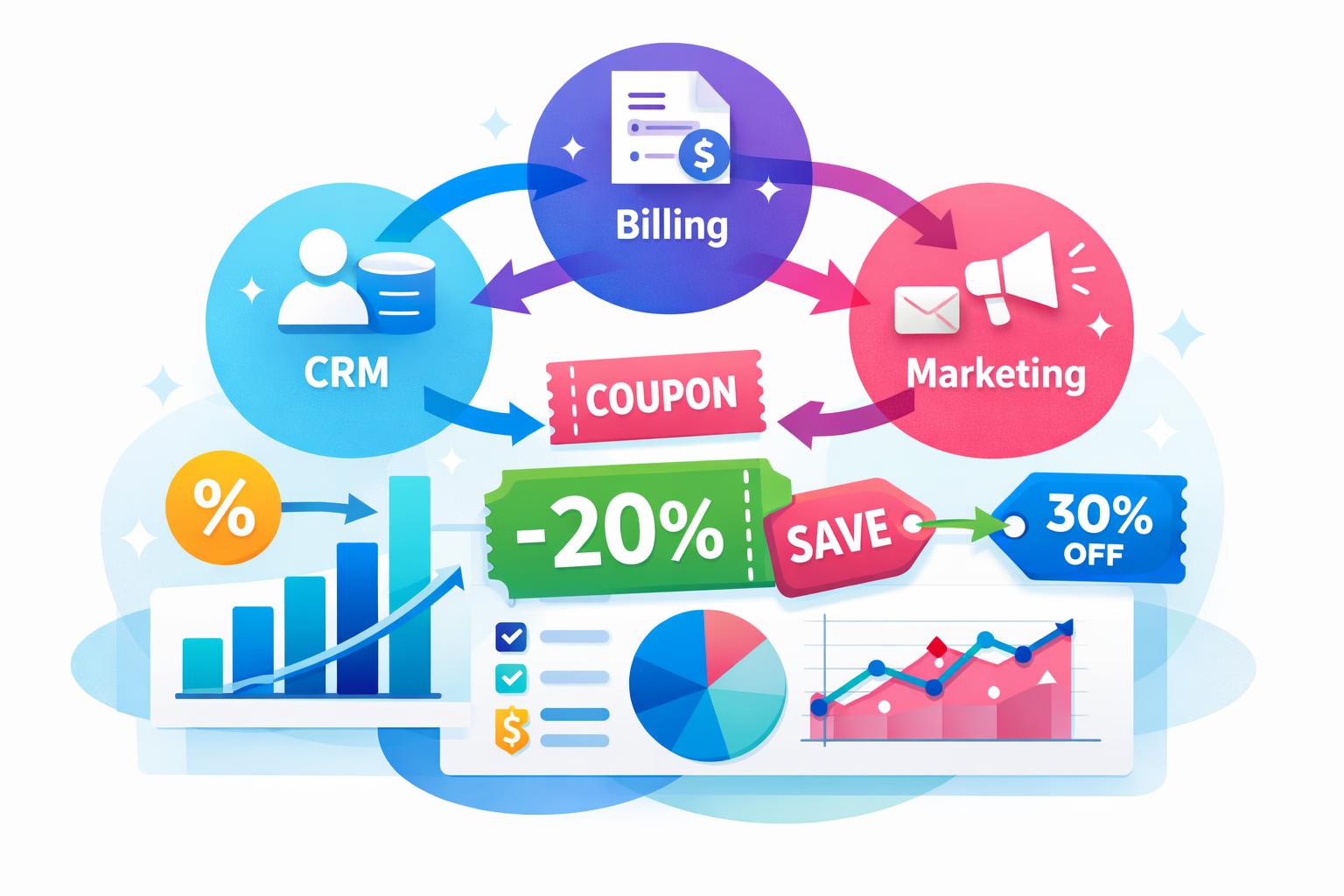
Offering discounts can be a smart growth lever for SaaS businesses—but only when managed strategically. Uncontrolled discounts often lead to lost revenue clarity, inconsistent pricing, and reduced margins. This article explores how modern SaaS discount and coupon management systems turn promotions into predictable growth drivers. We’ll cover the connection between discounts and revenue, why integration matters, and how platforms like MainFoundry make it simple to centralize and measure every promotion across billing, CRM, and marketing data.
Building an Integrated Discount Strategy That Actually Supports Growth
Discounts go beyond checkout—they influence how prospects perceive value, guide sales negotiations, and shape financial forecasts. In many SaaS environments, promotions start as quick fixes handled manually in tools like Stripe or spreadsheets. Over time, that patchwork becomes unmanageable, introducing pricing inconsistencies and making it difficult for finance to track whether growth comes from real demand or aggressive discounts.
Effective discount and coupon management centralizes control. Instead of scattered logic, promotions become part of the subscription lifecycle—directly linked to plans, billing cycles, and customer segments. Platforms such as MainFoundry’s billing and subscription management tools make it possible for every discount to be measurable and revenue-aligned from the start.
Another major benefit is alignment. Marketing might run a seasonal campaign, sales could be negotiating a custom deal, and finance needs revenue predictability. When everyone operates from one shared system, discount rules stay consistent and measurable. That clarity prevents promotions from confusing customers or distorting revenue data over time.
“Smart discount management isn’t about offering less—it’s about offering purposefully and measuring precisely.”
Using Discounts to Drive Conversions Without Eroding Revenue
Discounts are most effective when they’re intentional, time-bound, and tied to measurable outcomes. SaaS teams often use them to encourage trial-to-paid conversions, promote annual billing, and run limited-time offers. The key to success lies in targeting and tracking results in real time, rather than running blanket promotions.
For example, end-of-trial discounts can encourage engagement, but only when triggered by meaningful in-app behavior. By connecting product usage and CRM data, qualified prospects can receive custom offers that feel like rewards—not desperation. With MainFoundry’s integrated CRM, those interactions are visible at a glance, allowing teams to allocate offers where they’ll actually convert quality customers.
Annual billing discounts also improve retention and cash flow when applied consistently. Rather than manually creating coupon codes, automated rules ensure recurring savings apply uniformly during renewals and upgrades. That consistency lets finance maintain clean MRR and ARR data without manual corrections later.
Marketing-driven campaigns are another area where measurement often fails. Teams track redemptions but can’t connect them to actual revenue performance. By combining discounts with marketing analytics and attribution, MainFoundry helps identify which channels bring high-quality, long-term customers. This transforms coupon campaigns from guesswork into repeatable, data-backed strategies.
Pro Tip: Pair every discount with a defined goal—conversion, retention, or acquisition—and measure its direct impact on revenue metrics like MRR or ARR.
Key Takeaways
- Treat discounts as strategic levers, not reactive fixes—link them to defined growth goals.
- Keep all discount data visible across CRM, billing, and finance for consistent reporting.
- Use measurable metrics like MRR, ARR, and retention to evaluate every promotion’s success.
- Adopt integrated tools such as MainFoundry to unify discounts, subscriptions, and analytics in one place.
- When your team is ready to run promotions with clarity, start the conversation at MainFoundry’s contact page.